

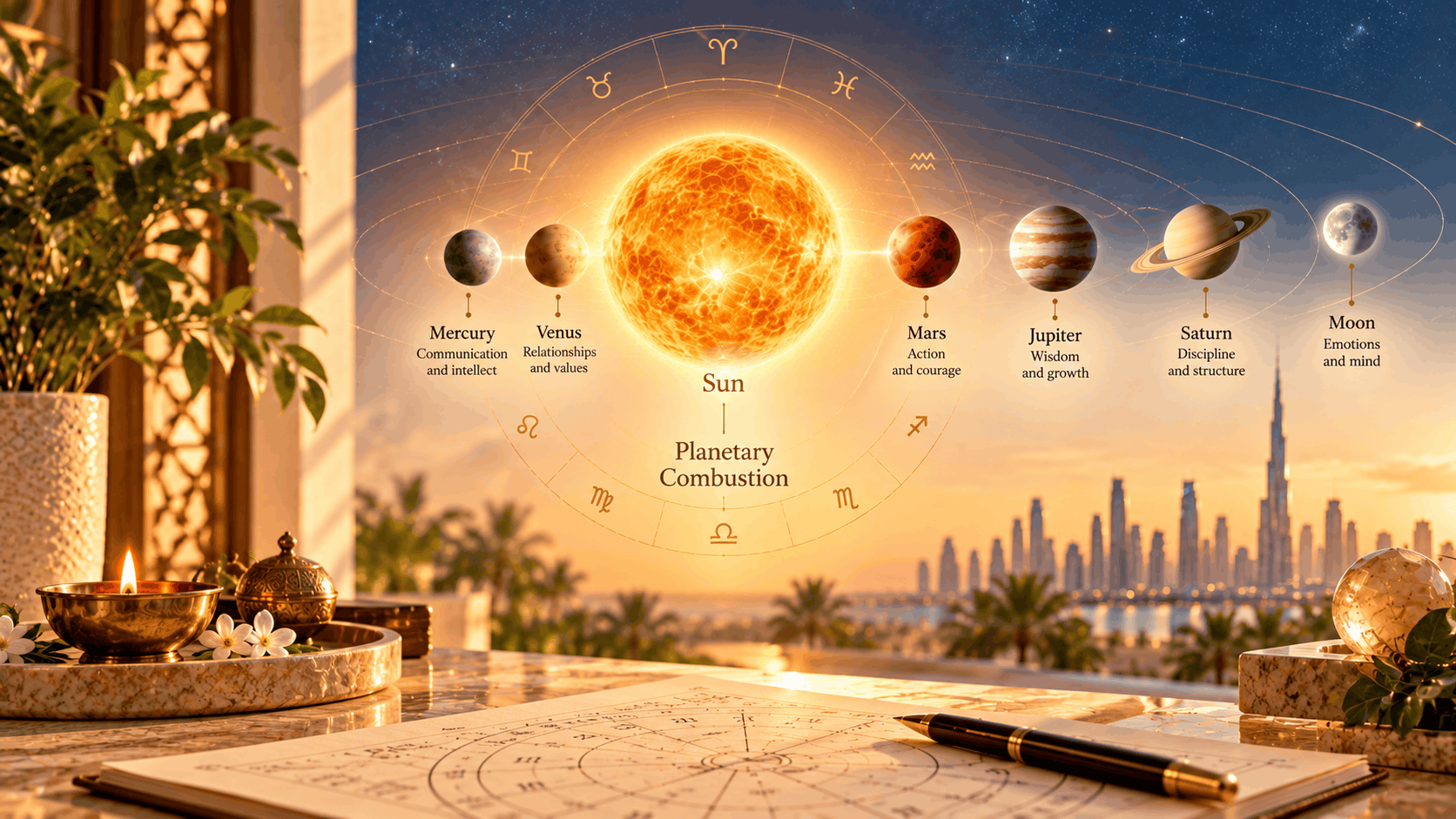
Planetary combustion is a condition in Vedic astrology that occurs when a planet comes very close to the Sun in the birth chart. Because the Sun is considered intensely hot and radiant, the nearby planet is traditionally believed to become less visible or less able to express its qualities independently.
A combust planet is not automatically weak, damaged, or negative. Its interpretation depends on the exact distance from the Sun, the planet involved, its sign, house, dignity, aspects, conjunctions, planetary strength, and timing. Some planets, such as Mercury and Venus, frequently come close to the Sun, so combustion is relatively common for them.
For a balanced Vedic astrology consultation in Dubai, planetary combustion should be assessed as one factor within the complete horoscope rather than used to make an isolated prediction.
In a birth chart, the Sun and the other planets are measured by their degree positions. When a planet comes within a certain distance of the Sun, it is considered combust.
The traditional interpretation is that the Sun’s heat and brightness overpower the nearby planet. The planet may still exist in the chart, but its qualities may become:
The result can be constructive or challenging. A combust Mercury may produce deep thinking, strong concentration, or difficulty expressing thoughts under pressure. A combust Venus may create intense relationship experiences, strong artistic focus, or conflict between personal desires and self-worth.
The planet’s house and role in the chart determine where these themes appear.
Combustion is identified by calculating the angular distance between the Sun and the planet. Each planet has a traditional combustion range, although the exact limits may vary between astrological schools.
Approximate ranges commonly discussed include:
These figures are general references, not universal rules. Some astrologers use different thresholds based on whether a planet is direct, retrograde, approaching the Sun, or moving away from it.
The closer the planet is to the Sun, the more strongly combustion may be considered. However, the exact degree should not be interpreted without checking the planet’s dignity, house position, aspects, and overall strength.
No. Combustion and debilitation are different conditions.
A debilitated planet is placed in the sign where its traditional strength is considered lowest. A combust planet is close to the Sun, regardless of whether it is exalted, in its own sign, or in another sign.
A planet can be combust but well placed by sign. It may also be debilitated without being combust. In some charts, both conditions may occur at the same time, creating a more complicated interpretation.
Combustion concerns the planet’s proximity to the Sun. Debilitation concerns its sign dignity. They should not be confused.
A combust planet may still receive support from benefic aspects, own-sign placement, exaltation, divisional charts, strong house placement, or favorable planetary periods.
Mercury and Venus are more frequently combust because their orbits keep them relatively close to the Sun. This means their combustion requires careful interpretation and should not automatically be treated as a major defect.
Mercury represents communication, learning, analysis, logic, writing, trade, calculation, and decision-making. When combust, these areas may become closely tied to the Sun’s themes of identity, authority, confidence, recognition, or leadership.
A person may think intensely, speak with authority, or perform well in analytical situations. However, they may also overthink, become impatient when misunderstood, or find it difficult to separate personal identity from opinions.
The house ruled and occupied by Mercury shows where these patterns are most visible.
Venus represents relationships, affection, beauty, art, comfort, values, pleasure, luxury, and social harmony. When combust, the person may experience strong desires or may connect love and self-worth very closely.
There may be artistic intensity, a refined sense of taste, or a strong wish for meaningful relationships. In challenging conditions, the person may struggle with approval, attachment, emotional disappointment, or balancing personal desires with external expectations.
A combust Venus is not proof of relationship failure. The seventh house, its lord, Jupiter, Navamsa chart, aspects, and planetary periods must also be assessed.
Mars represents courage, action, energy, competition, physical effort, conflict, and initiative. Combust Mars may intensify ambition and the desire to act independently.
The person may have strong drive and determination, but anger, impatience, frustration, or clashes with authority may also become more noticeable. The individual may need to learn how to use power decisively without becoming reactive.
Jupiter represents wisdom, teachers, beliefs, ethics, education, children, prosperity, and guidance. Combust Jupiter may make personal beliefs strongly connected with identity or authority.
A person may have a private or deeply internal relationship with faith and learning. In difficult conditions, overconfidence, rigid beliefs, or conflict with teachers and institutions may require attention.
The condition of the fifth and ninth houses, Jupiter’s sign, aspects, divisional placements, and dasha are important.
Saturn represents discipline, responsibility, work, delay, structure, endurance, service, and long-term obligations. Combust Saturn may make responsibilities feel closely tied to identity and self-worth.
The person may carry pressure to prove themselves or may experience difficulty separating personal value from achievement. With support, this placement can encourage patience, resilience, and serious long-term work.
The interpretation depends heavily on Saturn’s house ownership, sign, aspects, strength, and planetary periods.
The Moon is sometimes considered combust when it is very close to the Sun, particularly near the new Moon. This condition may be discussed in relation to emotional visibility, mental rest, confidence, and the ability to process feelings.
The Moon’s phase, sign, house, dignity, and relationship with other planets should be checked carefully. A close Sun–Moon relationship does not automatically indicate emotional difficulty.
The Sun represents identity, authority, vitality, leadership, confidence, father figures, government, recognition, and personal purpose. When another planet is close to it, that planet may express its qualities through these themes.
For example:
The Sun does not simply destroy the planet. It can absorb the planet’s energy into questions of identity and purpose.
This may make the planet less outwardly visible but more important internally. The person may spend years learning how to express the planet’s qualities without allowing ego, fear, or the need for recognition to control them.
Combustion occurs because a planet is close to the Sun. Planetary war, or Graha Yuddha, generally involves two planets being very close to each other, according to specific traditional rules.
They are separate conditions, although they can occur together. If a combust planet is also involved in planetary war, the interpretation becomes more complex.
The astrologer should check the exact degrees, the planets involved, their relative strength, the sign, house, aspects, and the relevant divisional charts. A software label alone does not provide a complete interpretation.
This is one reason readers should be cautious about simple online statements such as “combustion always destroys a planet.” Traditional astrology contains several modifying factors.
Readers who want to understand common misunderstandings can review astrology misconceptions and their practical interpretation.
No. Combustion can create difficulty, but it may also produce focus, intensity, discipline, insight, and strong identification with the planet’s qualities.
A combust planet may become powerful in a different way. The person may develop deep expertise in the areas represented by that planet because those themes require continuous attention.
For example, combust Mercury may encourage someone to work deeply with communication, research, business, technology, or analysis. Combust Saturn may create a strong capacity for responsibility after the person learns how to manage pressure. Combust Venus may encourage artistic expression or a deeper understanding of relationships.
The final result depends on the complete horoscope. The planet’s condition in the Navamsa, its relationship with the ascendant lord, benefic support, and active dasha can significantly change the outcome.
The house occupied by the combust planet shows the area of life where its themes may become more intense or internalized.
A combust planet in the second house may affect speech, family values, savings, or confidence around resources. In the fourth house, it may connect with home, emotional security, property, or the relationship with the mother. In the seventh house, relationships, agreements, and public dealings may become important.
A combust planet in the tenth house may connect professional identity with authority, responsibility, visibility, or recognition. In the twelfth house, the experience may be more private and connected with foreign places, retreat, expenses, sleep, or spiritual reflection.
The house lordship also matters. The same combust planet may produce different results for people with different ascendants.
Benefic aspects, own-sign placement, exaltation, strong divisional-chart positions, and supportive yogas may reduce the difficulty associated with combustion. Challenging aspects, weak dignity, difficult house ownership, or additional afflictions may make the themes more demanding.
Planetary strength should be assessed through more than combustion. An astrologer may consider Shadbala, positional strength, directional strength, dignity, motion, aspects, and the planet’s condition in divisional charts.
A planet that is combust but strong in other ways may continue to deliver meaningful results. A planet that is combust and weak across several measures may require greater patience and conscious effort.
This is why no planet should be judged from one label alone.
The results of combustion may become more noticeable during the dasha or sub-period of the combust planet. The houses it rules and occupies may become active, bringing related decisions, responsibilities, opportunities, or challenges.
The Sun’s dasha may also highlight the combust planet because the two planets are closely connected. The experience depends on the Sun’s house, sign, strength, and relationship with the planet.
Transits can activate the natal Sun, combust planet, its house, or related timing points. These periods may bring greater visibility to issues involving career, communication, relationships, education, finances, or responsibility.
Astrological timing should be interpreted carefully rather than used to create fear. A broader discussion of long-term cycles can be found in planning through astrology over several years.
Some Vedic astrology traditions recommend remedies such as mantras, charitable acts, disciplined routines, devotional practices, or respectful behavior toward people represented by the planet.
The appropriate remedy depends on the complete chart. Strengthening a planet without considering its house ownership may not always be suitable. Remedies should also be practical, voluntary, and consistent with the person’s beliefs.
No remedy should replace medical care, financial planning, legal advice, education, or responsible personal action. The most useful approach often combines awareness of the planet’s tendencies with constructive habits.
For example, combust Mercury may benefit from clearer communication and careful decision-making. Combust Mars may require better anger management and responsible use of energy. Combust Saturn may call for patience, structure, and realistic long-term planning.
A detailed review may be useful when a combust planet rules an important house, is involved in a major dasha, sits close to the Sun, or appears connected with a recurring life concern.
Prepare accurate birth date, time, and place details. Ask the astrologer to explain:
People considering an astrology session may also review when it may be appropriate to consult an astrologer.
Planetary combustion occurs when a planet comes within a specific degree range of the Sun. The planet may become less outwardly visible or more closely connected with identity, authority, and personal purpose.
No. Combustion may create challenges, but it can also produce focus, intensity, expertise, discipline, and strong identification with the planet’s themes.
Mercury and Venus are commonly combust because they remain relatively close to the Sun. Mars, Jupiter, Saturn, and the Moon may also become combust depending on their degree distance.
Yes. Sign dignity, house placement, aspects, divisional charts, planetary strength, yogas, and dashas may support a combust planet and improve its expression.
There is no single universal cancellation rule accepted by every tradition. The effects may be reduced or modified by strength, dignity, benefic aspects, own-sign placement, divisional support, and favorable timing.
Planetary combustion describes a close relationship between the Sun and another planet. It may make the planet’s qualities more private, intense, identity-driven, or difficult to express independently, but it does not automatically destroy the planet’s results.
The planet involved, exact degree distance, sign, house, dignity, aspects, conjunctions, divisional charts, strength, dashas, and transits must all be considered. A combust planet can create pressure, but it may also encourage concentration, maturity, discipline, and deeper self-understanding.
A balanced interpretation avoids fear-based conclusions and explains how the placement may operate in real life. When studied within the full birth chart, combustion becomes one useful factor in understanding planetary expression and personal development.


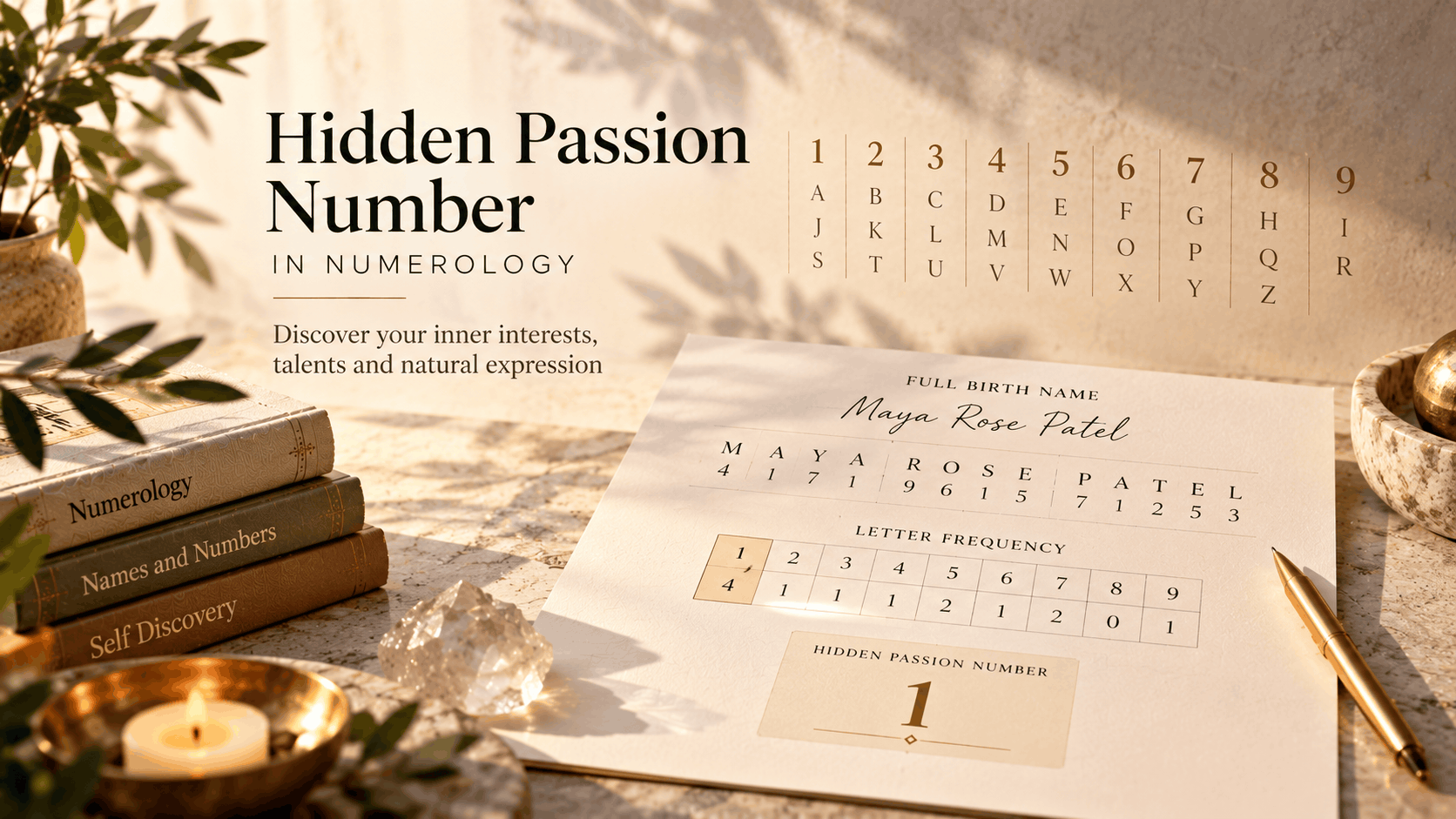 " alt="What Does a Hidden Passion Number Reveal in Numerology?">

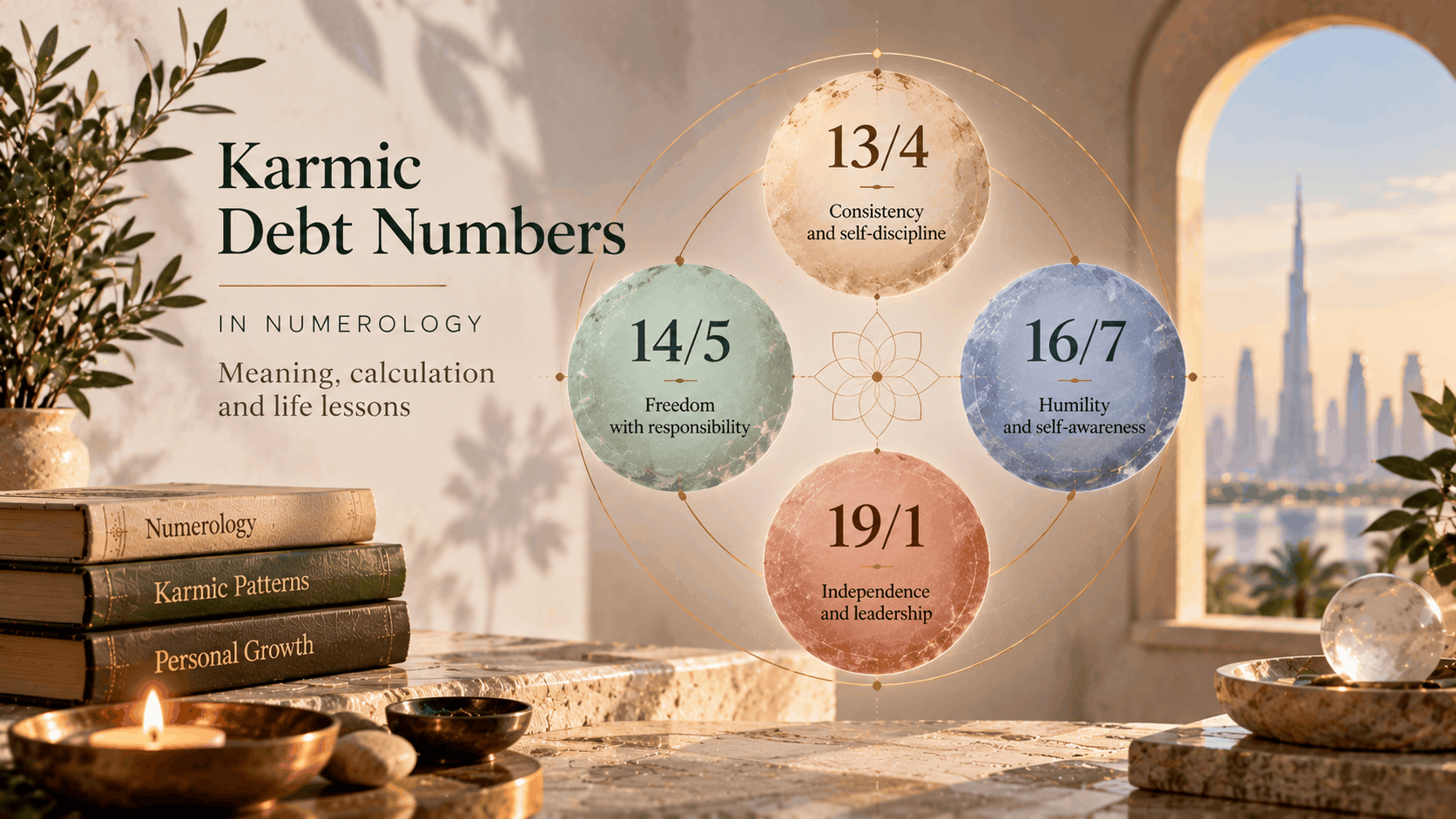 " alt="What Are Karmic Debt Numbers in Numerology?">
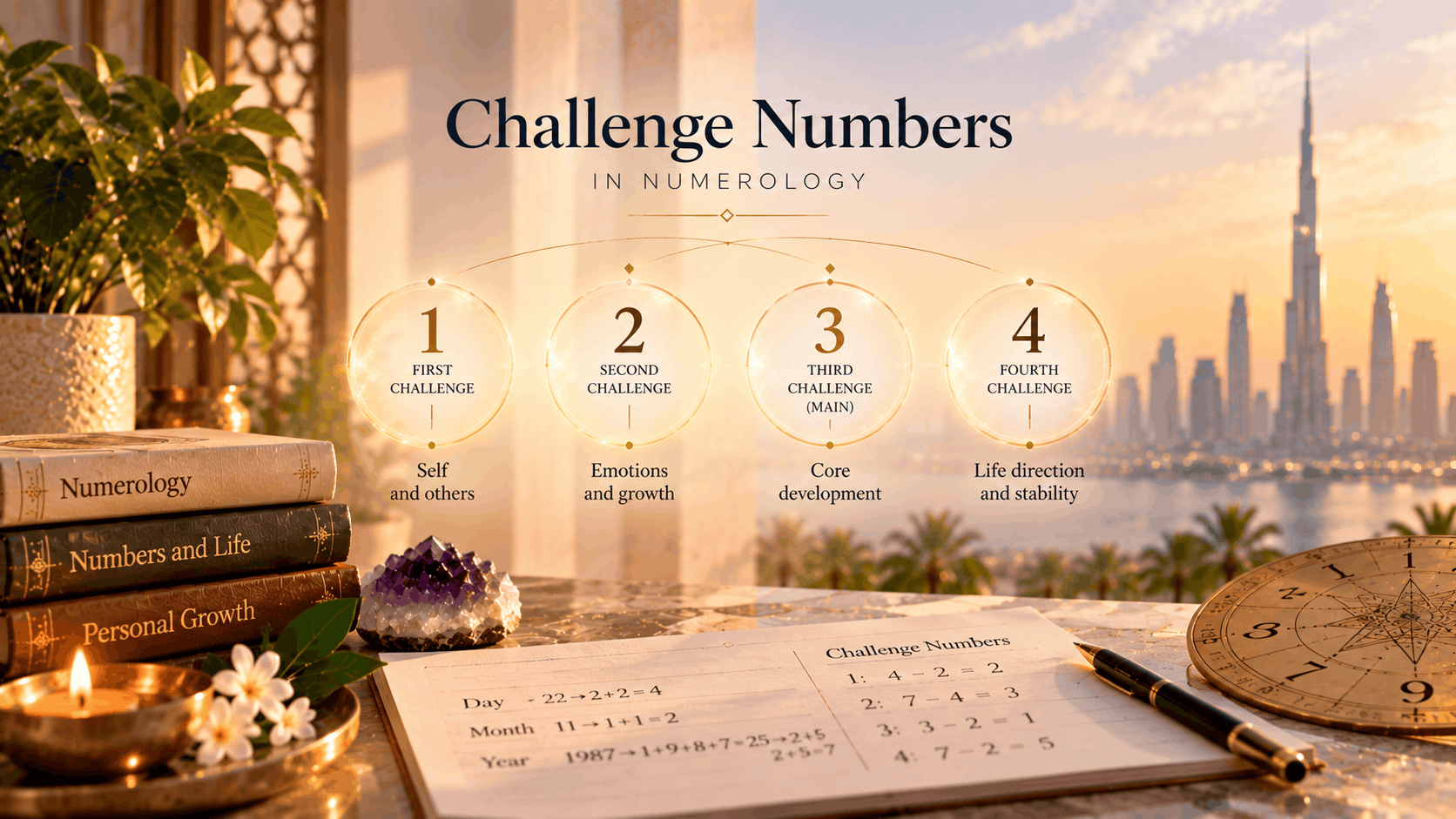 " alt="How Are Challenge Numbers Calculated in Numerology?">
 " alt="What Is a Numerology Maturity Number and When Does It Become Relevant?">