

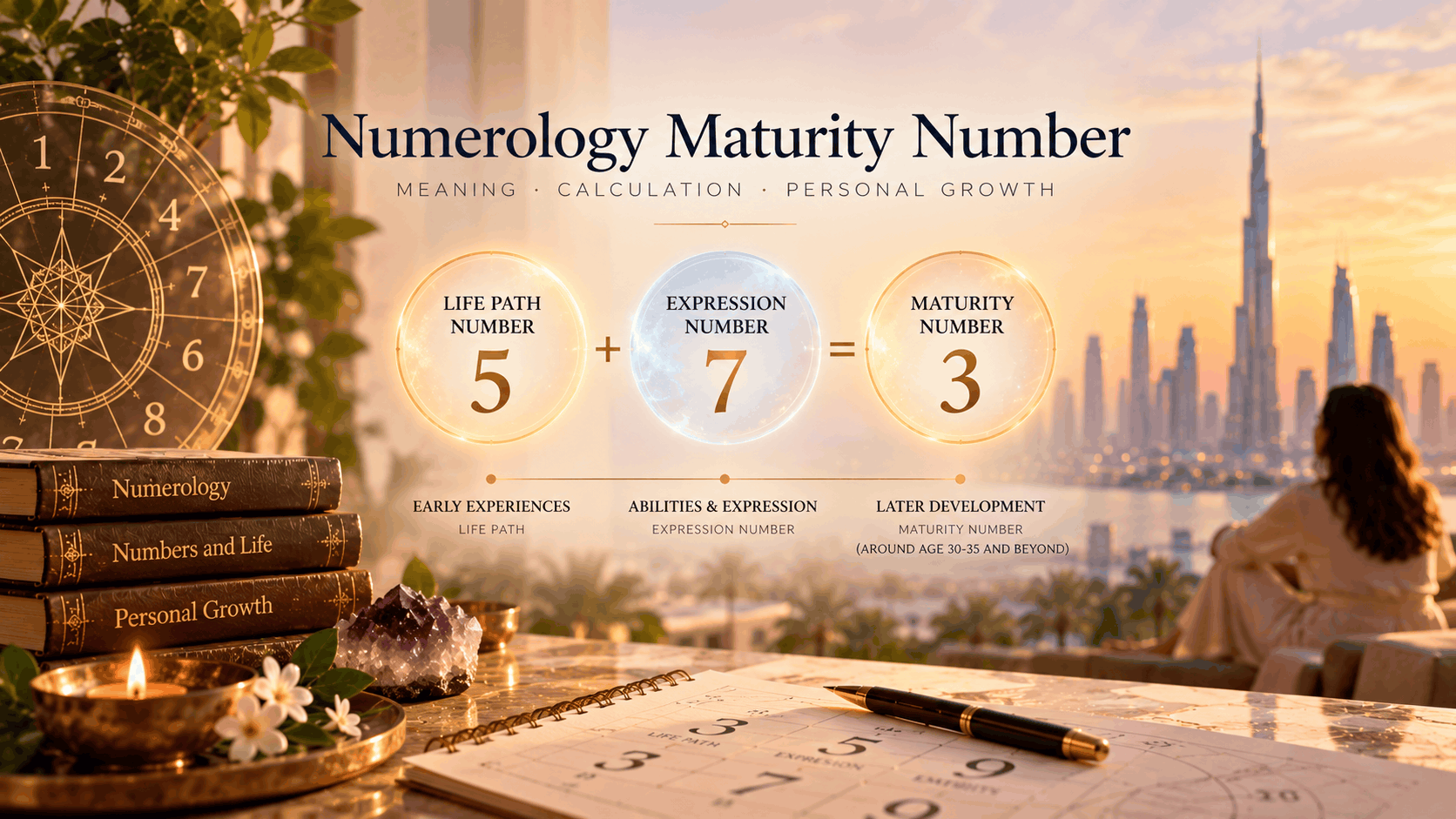
A Numerology Maturity Number is a calculated number that practitioners interpret as a theme of personal development becoming clearer with experience. In Western Pythagorean numerology, it combines the Life Path Number, derived from the birth date, with the Expression Number, derived from the full birth name.
People often encounter it when reassessing their priorities, responsibilities, or sense of purpose. Its appeal lies in connecting earlier experiences with the qualities they want to develop next. Numerology is a symbolic belief system; its interpretations are not scientifically established predictions of personality or future events.
Within this tradition, the Life Path describes broad life themes, while the Expression Number represents abilities and ways of expressing yourself. The Maturity Number combines these two perspectives into a theme for later development.
Calling it a “maturity” number does not mean it measures emotional intelligence or proves someone has become wiser. That distinction helps address common myths about numerology, including the idea that a number determines someone’s entire future.
For example, a reading associated with communication might encourage someone to reflect on how they share their knowledge. It cannot establish that they must become a writer, teacher, or public speaker. The interpretation remains open to the individual’s circumstances.
For this method, use the complete birth date and full birth name, including middle names. Do not substitute a nickname or shortened professional name without explaining the change.
Preparing the details needed for a first numerology consultation helps keep the calculation consistent. Record the original name, later names, and any uncertainty about spelling separately.
This matters for Dubai residents whose names appear differently across languages or documents. Different transliterations can produce different letter totals. A practitioner should explain which spelling and alphabet system they use.
If two calculators disagree, compare their input fields before interpreting either result. Missing middle names, different spellings, or different reduction settings can explain the discrepancy without adding symbolic meaning.
Terminology also varies. “Destiny Number” can refer to different calculations across numerology traditions. Confirm that the second number in this formula is the name-based Expression Number.
Decoz associates its growing significance with approximately ages 30 to 35 and later adulthood. This is a traditional interpretive timeline, rather than a measurable change that happens on a specific birthday.
Someone might find the symbolism interesting earlier, while another person may revisit it after becoming a parent, changing careers, or taking on different responsibilities. Those events have their own practical and personal causes.
You do not need to wait until 35 or 40 to reflect on your priorities. Equally, reaching those ages does not mean a predicted transformation must occur. The useful question is whether the interpretation prompts an honest examination of your experience.
The following themes draw on conventional single-digit numerology meanings. The reflection questions show how someone might explore that symbolism without treating it as a prescribed future.
| Number | Traditional theme | Possible reflection |
| 1 | Independence and initiative | Where could I take responsibility for my choices? |
| 2 | Cooperation and sensitivity | How can I collaborate while keeping boundaries? |
| 3 | Creativity and communication | What would I like to express more clearly? |
| 4 | Order and practical effort | Which habits would support my longer goals? |
| 5 | Freedom and adaptability | How can I welcome change responsibly? |
| 6 | Care and responsibility | Where does caring need healthier limits? |
| 7 | Inquiry and reflection | What deserves deeper study or thought? |
| 8 | Leadership and resources | How can I exercise authority responsibly? |
| 9 | Compassion and completion | What could I contribute or release? |
These are broad symbolic associations. A number associated with leadership does not guarantee professional status, and one associated with care does not require a particular family arrangement.
Some numerology approaches preserve selected repeated totals as master numbers, commonly 11 and 22, with 33 recognized in some contexts. Others reduce the Maturity Number to a single digit.
If your Life Path is 5 and Expression is 6, their sum is 11. A single-digit method reports 2; a method retaining that master total may report 11/2. The difference comes from the stated convention.
Ask how master numbers are handled both in the starting calculations and in the final sum. Mixing calculator settings makes comparisons confusing. A master-number label does not establish superior character or greater potential.
Understanding why people with the same numerology numbers can have different life paths prevents a Maturity Number from becoming a rigid personality label.
For example, Life Path 1 plus Expression 2 gives Maturity 3. Life Path 5 plus Expression 7 also reduces to 3. The final digit matches, but the starting numbers differ.
Practitioners may interpret those combinations differently. Beyond any reading, upbringing, opportunities, relationships, culture, and personal decisions influence how someone develops.
The Maturity Number also differs from a Personal Year Number. The former stays tied to the original birth information; the latter is calculated for a particular year. Neither should be silently substituted for the other.
Start with a specific question rather than a prediction. You might ask whether you want more creative activity, greater consistency, stronger boundaries, or deeper learning in your daily life.
When considering numerology alongside important life decisions, compare the symbolic theme with your actual options, commitments, skills, and resources. A reflective reading can suggest questions; it cannot supply all the evidence needed for a decision.
Choose a modest action you can evaluate. Someone exploring communication might join a discussion group or practice explaining an idea. Someone considering responsibility might review an overloaded schedule. Neither action requires believing a particular outcome is destined.
A useful numerology consultation in Dubai should make the calculation understandable and relate the interpretation to the questions you brought.
Ask which name was used, how both starting numbers were calculated, and whether master numbers were retained. The explanation should separate arithmetic from symbolic interpretation and leave room for your own judgment.
No. The Life Path comes from the birth date. The Maturity Number combines that result with the Expression Number, although both can sometimes share the same final digit.
Under the birth-name method described here, it does not. A later surname may be analyzed separately, but substituting it changes the inputs and should be clearly identified.
No. This calculation uses the birth date and name. Birth time belongs to other systems of interpretation and is unnecessary for the formula explained here.
No reliable evidence supports that claim. Its traditional meaning concerns broad development themes, not a guaranteed promotion, relationship milestone, financial result, or date of achievement.
You do not need to force a match. Check the calculation and terminology, then decide whether the symbolism offers anything useful. Your lived experience matters more than fitting a description.
A Maturity Number brings together two established numerology calculations to suggest a theme for personal reflection. Understanding its inputs, reduction rules, and traditional timing helps you read it with appropriate perspective.
For anyone exploring later priorities, its most constructive use is to encourage thoughtful questions. Keep your circumstances, choices, and practical responsibilities central as you consider what you want to develop next.


 " alt="What Does a Hidden Passion Number Reveal in Numerology?">

 " alt="What Are Karmic Debt Numbers in Numerology?">
 " alt="How Are Challenge Numbers Calculated in Numerology?">
 " alt="What Is Ayanamsha and Why Can It Change a Birth-Chart Reading?">