

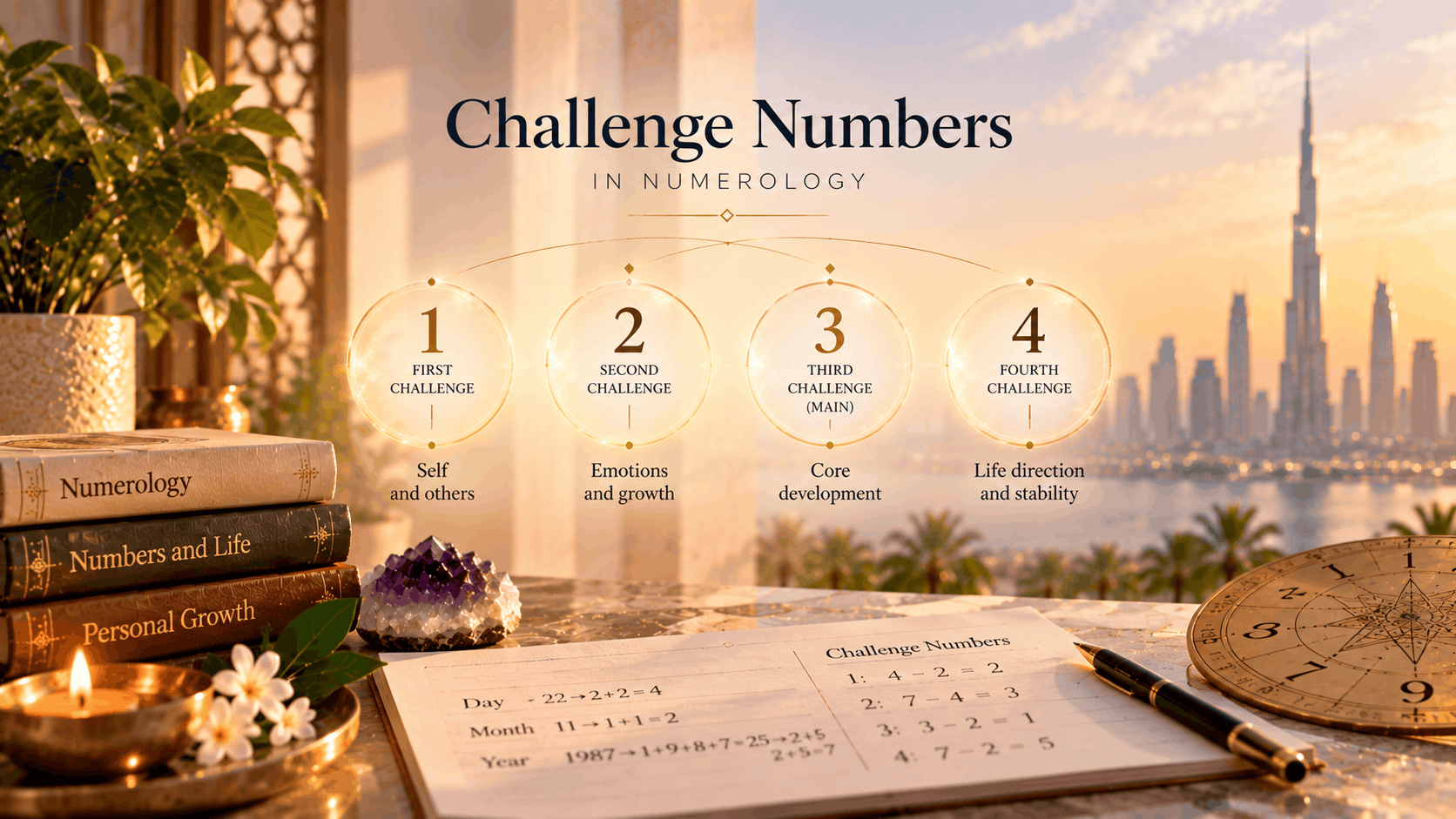
Challenge Numbers are calculated by reducing the birth month, day, and year separately to single digits, then finding the differences between specific pairs. In the common four-Challenge method, three calculations use those birth-date values directly; the remaining calculation compares the first two Challenge Numbers.
These results are traditionally interpreted as themes for personal development, such as independence, cooperation, or responsibility. Numerology is a symbolic belief system, and its interpretations are not scientifically established measures of character or future events. Understanding the calculation helps you separate a reproducible mathematical result from the meaning assigned to it.
You need your complete birth date: month, day, and year. Your name, current age, address, and telephone number do not enter this calculation.
Write the month in words before beginning. For example, November 4 is clearer than 04/11, which people may interpret differently depending on their date format. This is particularly useful when sharing details internationally.
Keeping the original date beside your working also makes a first numerology consultation easier to follow. A practitioner can check each step instead of relying on an unexplained calculator result.
Reduce the month, day, and year individually by adding their digits until each becomes a number from 1 through 9.
For a November birthday, the month is 11, so calculate 1 + 1 = 2. For a birth day of 22, calculate 2 + 2 = 4.
Reduce the complete year as well. For 1987:
1 + 9 + 8 + 7 = 25; 2 + 5 = 7.
In this Challenge Number method, master numbers are reduced too. Keep reducing 11 to 2, 22 to 4, and 33 to 6 whenever they occur in the component totals. Rules used for other numerology calculations should not be transferred automatically.
Label the three results M for month, D for day, and Y for year.
The four-Challenge calculation described by Hans Decoz uses the following relationships:
| Challenge | Values to compare | Calculation rule |
| First | Reduced month and reduced day | Larger value minus smaller value |
| Second | Reduced day and reduced year | Larger value minus smaller value |
| Third, or Main | First and Second Challenge results | Larger result minus smaller result |
| Fourth | Reduced month and reduced year | Larger value minus smaller value |
“Difference” means the distance between the two values. Comparing 2 and 7 therefore gives 5, whichever value appears first.
The Third Challenge is the step most easily confused: it uses two previous results. The Fourth returns to the reduced birth-date components.
For this fictional birth date, the starting values are:
| Component | Reduction | Final value |
| November | 1 + 1 | 2 |
| Day 22 | 2 + 2 | 4 |
| Year 1987 | 1 + 9 + 8 + 7 = 25; 2 + 5 | 7 |
Now calculate each Challenge:
The complete sequence is 2, 3, 1, 5.
As a quick check, the Main Challenge cannot exceed the larger of the first two results. Here, those results are 2 and 3, so a reported Main Challenge of 6 would reveal an arithmetic error before you begin considering what that number might mean.
Record the labels alongside the numbers. Writing only “my Challenge Number is 1” leaves out whether you mean the Main Challenge or another position. A labeled sequence lets someone else check your work accurately.
Yes. Equal values produce zero, and zero remains the result.
For someone born on April 13, the reduced month is 4 and the reduced day is also 4. Their First Challenge is therefore 4 − 4 = 0, regardless of the birth year.
Do not replace zero with 9 or remove it from the sequence. The arithmetic result and its symbolic interpretation are separate matters.
Assuming zero guarantees an effortless life is among the numerology misconceptions worth questioning. A zero result cannot establish that someone will avoid responsibilities, setbacks, or difficult choices.
Every reduced birth-date component falls between 1 and 9. The largest possible difference between two such values is 9 − 1 = 8.
The First, Second, and Fourth Challenges must therefore fall between 0 and 8. Since the Third compares two results within that same range, it also cannot exceed 8.
A result of 9, 11, or a negative number indicates that you should review the calculation or confirm whether the calculator uses another system. No additional digit reduction is needed after correctly completing these subtractions.
Traditional Challenge Number interpretations associate the results with areas for reflection. The descriptions below are broad themes, not diagnoses.
| Number | Common interpretive theme |
| 0 | Choosing which areas of personal development to address |
| 1 | Building independence while respecting others |
| 2 | Balancing cooperation, sensitivity, and confidence |
| 3 | Developing clearer expression and creative confidence |
| 4 | Practicing consistency without becoming inflexible |
| 5 | Balancing freedom with responsible choices |
| 6 | Accepting responsibility without controlling others |
| 7 | Combining reflection with communication and connection |
| 8 | Considering the responsible use of authority and resources |
Start by asking whether a theme relates to an observable habit. For example, communication might mean preparing your thoughts before a meeting. It does not require accepting every description attached to the number.
A Birth Number commonly comes from the day alone, while the Life Path uses the complete birth date through addition and reduction. Challenge Numbers use subtraction between separately reduced components.
When exploring birth numbers in career numerology, keep those labels distinct. A reduced birth day of 4 does not automatically produce a Challenge Number of 4.
Name-based numbers involve another input altogether. Recording the calculation beside each label prevents different parts of a reading from being confused.
Review your working in this order:
If two calculators disagree, compare these steps before comparing interpretations. Also check whether one displays three Challenges while the other displays four.
Timing conventions vary. Decoz treats the Third as a lifelong Main Challenge and describes the others through broad, overlapping life periods.
Other presentations may use different stage boundaries. Ask which convention a reading follows before assuming a particular birthday activates or ends a challenge.
The arithmetic itself does not change as you age because its birth-date inputs remain the same.
Choose one behavior you can observe and improve. If a theme concerns consistency, try finishing a small weekly commitment and reviewing what helped.
For founders exploring numerology before starting a business, a responsibility theme might prompt clearer task ownership or better delegation. Business decisions still need research, workable plans, and relevant expertise.
Use the theme to frame a question, then evaluate progress through actual behavior.
Yes. If the reduced month, day, and year are equal, all four results are zero. That follows directly from subtracting equal values.
Some traditions describe two minor Challenges and one major Challenge. Others include a fourth calculation. Confirm the method before treating the missing position as an error.
No. The numbers represent different symbolic categories, rather than a scale of hardship. An 8 is not automatically more difficult than a 2.
Yes. Different dates can reduce to the same component values. Identical results do not mean those people have identical personalities, experiences, or opportunities.
A numerology specialist in Dubai can explain the chosen method and review the inputs. Ask to see the arithmetic behind each result.
Calculate Challenge Numbers by reducing three birth-date components, completing four labeled subtractions, and preserving zero whenever it appears. Check those steps before interpreting the sequence.
The resulting themes can offer prompts for reflection. What you do with those questions depends on your circumstances, priorities, and choices.
 " alt="What Does a Hidden Passion Number Reveal in Numerology?">

 " alt="What Are Karmic Debt Numbers in Numerology?">
 " alt="What Is a Numerology Maturity Number and When Does It Become Relevant?">
 " alt="What Is Ayanamsha and Why Can It Change a Birth-Chart Reading?">

