

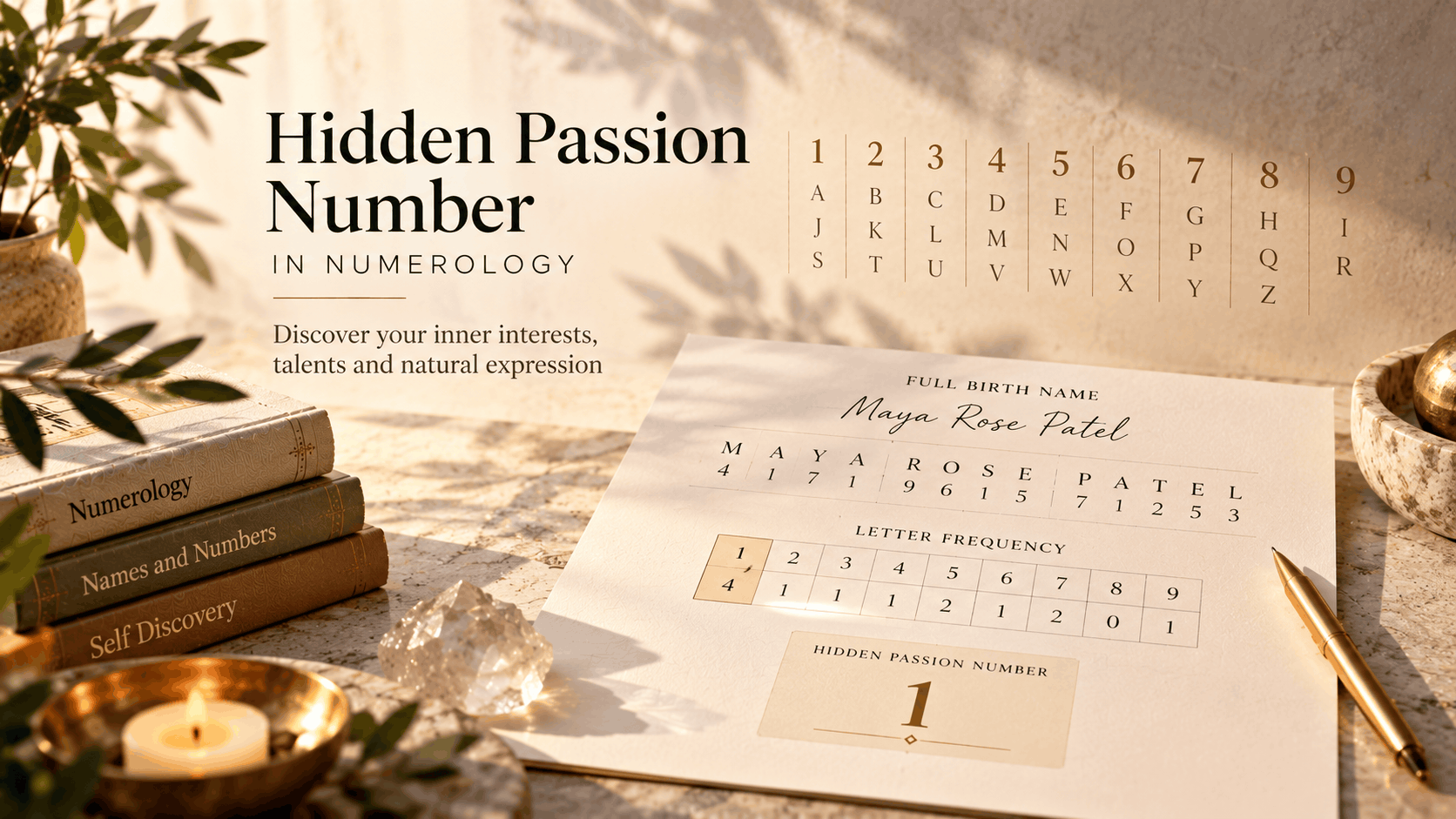
A Hidden Passion Number is traditionally interpreted as a concentrated interest, talent, or way of expressing yourself. In Pythagorean numerology, it is identified by finding which numerical value appears most frequently among the letters of your full birth name.
Practitioners use this pattern to discuss qualities someone might enjoy developing, such as communication, organization, investigation, or cooperation. It does not prove an ability or determine a career. Numerology is a symbolic belief system, and its personality interpretations are not scientifically established assessments.
The calculation is straightforward once you understand one distinction: you count how often each letter value appears, rather than adding all the values together.
The word “hidden” does not necessarily mean an unknown gift waiting to emerge. Within numerology, it can describe an interest that is familiar but has received little attention, practice, or opportunity.
“Passion” also has a broader meaning than romance. A reading might discuss enjoyment of solving problems, arranging activities, supporting others, or making something original.
Hans Decoz describes the Hidden Passion Number as the most frequently represented value in the full birth name and allows for more than one result.
A useful interpretation turns that symbolism into questions. Which activities hold your attention? What do you willingly practice? What feedback have you received about your strengths? These observations provide context that a letter tally cannot supply.
Start with the complete birth name, including middle names. Convert each letter using the repeating Pythagorean sequence from 1 through 9.
The same value can belong to several different letters. For example, A, J, and S all contribute to the count for 1. Counting only identical letters would miss that relationship.
Use this mapping:
| Value | Letters |
| 1 | A, J, S |
| 2 | B, K, T |
| 3 | C, L, U |
| 4 | D, M, V |
| 5 | E, N, W |
| 6 | F, O, X |
| 7 | G, P, Y |
| 8 | H, Q, Z |
| 9 | I, R |
Count every occurrence, including repeated letters. The value with the highest frequency becomes the Hidden Passion Number. Keep the numerical value and its frequency in separate columns so they cannot be confused.
Consider the fictional full birth name Maya Rose Patel.
Convert its letters:
Now tally the values across all three names:
| Value | Number of occurrences |
| 1 | 4 |
| 2 | 1 |
| 3 | 1 |
| 4 | 1 |
| 5 | 2 |
| 6 | 1 |
| 7 | 2 |
| 8 | 0 |
| 9 | 1 |
The highest frequency is four, belonging to the value 1. Therefore, the Hidden Passion Number is 1, not 4.
The three A letters and one S produce those four occurrences. As a checking step, add the frequencies: they total 13, matching the 13 letters in the name. Spaces are excluded.
Suppose the full birth name is Mila Rose. Its letter values are:
4, 9, 3, 1, 9, 6, 1, 5.
The values 1 and 9 each appear twice. Every other represented value appears once. Under the frequency method described here, the Hidden Passion Numbers are 1 and 9.
Do not add the tied values together or reduce them into a new result. Their equal frequency is the relevant feature.
Recognizing why people with matching numerology numbers can have different life paths helps here. One person may have a single leading value; another may share that value alongside a second, equally frequent result.
Use the full birth name for the birth-name method. A nickname, abbreviated signature, or professional name creates a different set of letters and may produce a different tally.
When preparing for a first numerology consultation, record your birth name and later name variations separately. This allows the practitioner to explain which version each calculation uses.
For Dubai residents with names written in multiple languages, transliteration needs attention. Different Latin-alphabet spellings can change the frequencies. Record the spelling convention instead of presenting one transliteration as universally correct.
An initial also represents fewer letters than a complete middle name. Substituting one changes the input.
Interpretations draw on traditional numerology meanings associated with single-digit numbers. The following themes are starting points for reflection.
| Number | Traditional area of interest | Question to explore |
| 1 | Initiative and independent effort | What would I enjoy starting? |
| 2 | Cooperation and sensitivity | When do I help people work together? |
| 3 | Communication and creativity | Which forms of expression interest me? |
| 4 | Organization and practical work | What do I enjoy arranging or improving? |
| 5 | Variety and adaptability | Which unfamiliar experiences keep me curious? |
| 6 | Care and responsibility | How do I like supporting others? |
| 7 | Analysis and deeper learning | Which subjects invite sustained investigation? |
| 8 | Management and achievement | What resources or projects interest me? |
| 9 | Compassion and wider contribution | Which causes or creative projects matter? |
Someone interested in number 3 might try photography, storytelling, or presenting ideas. The number does not establish which activity they will enjoy or how skilled they will become. Practice supplies information that symbolism alone cannot provide.
Several calculations can use the same name while producing different results.
The Expression Number adds the values of all letters. The Soul Urge Number uses vowels, while the Personality Number uses consonants. The Hidden Passion Number identifies the most frequent values across all letters.
A name could have a total that reduces to 6 while its most frequent letter value is 1. Those results answer different questions within the system.
Birth-date calculations use another input entirely. When exploring birth-number interpretations for career interests, avoid treating a date-based result as though it came from the name.
It can provide a theme to consider, but it cannot establish professional suitability. A person drawn to investigation might enjoy academic research, repairing equipment, interviewing customers, or studying languages.
Those activities require different skills, training, and working conditions. Reducing them to one prescribed occupation would overlook important differences.
Start with actual experience. Notice which tasks you return to willingly, where your performance improves with practice, and which environments help you concentrate. Consider interests that disagree with the reading too.
A name-based interpretation becomes more useful when it encourages exploration without narrowing your options prematurely.
Choose a small activity connected with the theme and give it a trial. For organization, arrange a community activity. For creative expression, complete a personal project.
Record what you enjoyed, what felt difficult, and whether you wanted to continue. This separates attraction to an idea from enjoyment of the activity itself.
If you discuss the result during a personalized numerology reading, bring those observations alongside the letter tally. They provide more useful context than asking a number to identify your entire purpose.
Check the full name before interpreting the result. Common errors include omitting middle names, counting a repeated letter only once, combining different spelling versions, or confusing the winning value with its frequency.
Do not add all letter values and call the reduced total a Hidden Passion Number. That performs a different operation.
For a simple verification, make sure the sum of all frequencies equals the number of letters counted. Then confirm that every value tied for the highest count has been retained.
Under this method, results come from values 1 through 9. Even if one value appears 11 times, 11 describes its frequency, not the Hidden Passion Number.
No. Y carries the value 7 in this mapping and is counted either way. Its vowel role matters for other calculations, such as the Soul Urge Number.
They have no numerical value in the letter mapping used here. Count the letters on both sides of punctuation while keeping every part of the chosen name.
A business name produces a separate tally. When considering numerology for a new business, distinguish that exercise from a personal Hidden Passion reading based on your birth name.
No. An absent value only means no counted letters mapped to it. It cannot establish that you are incapable of learning, enjoying, or succeeding at a related activity.
A Hidden Passion Number identifies a frequency pattern in a name and gives that pattern a traditional interpretation. Careful counting keeps the method understandable, including cases with tied results.
The more revealing step is exploring an interest in practice. Use the interpretation to ask better questions, try an activity, and notice what experience teaches you about your preferences and abilities.
 " alt="What Are Karmic Debt Numbers in Numerology?">

 " alt="How Are Challenge Numbers Calculated in Numerology?">
 " alt="What Is a Numerology Maturity Number and When Does It Become Relevant?">
 " alt="What Is Ayanamsha and Why Can It Change a Birth-Chart Reading?">

