

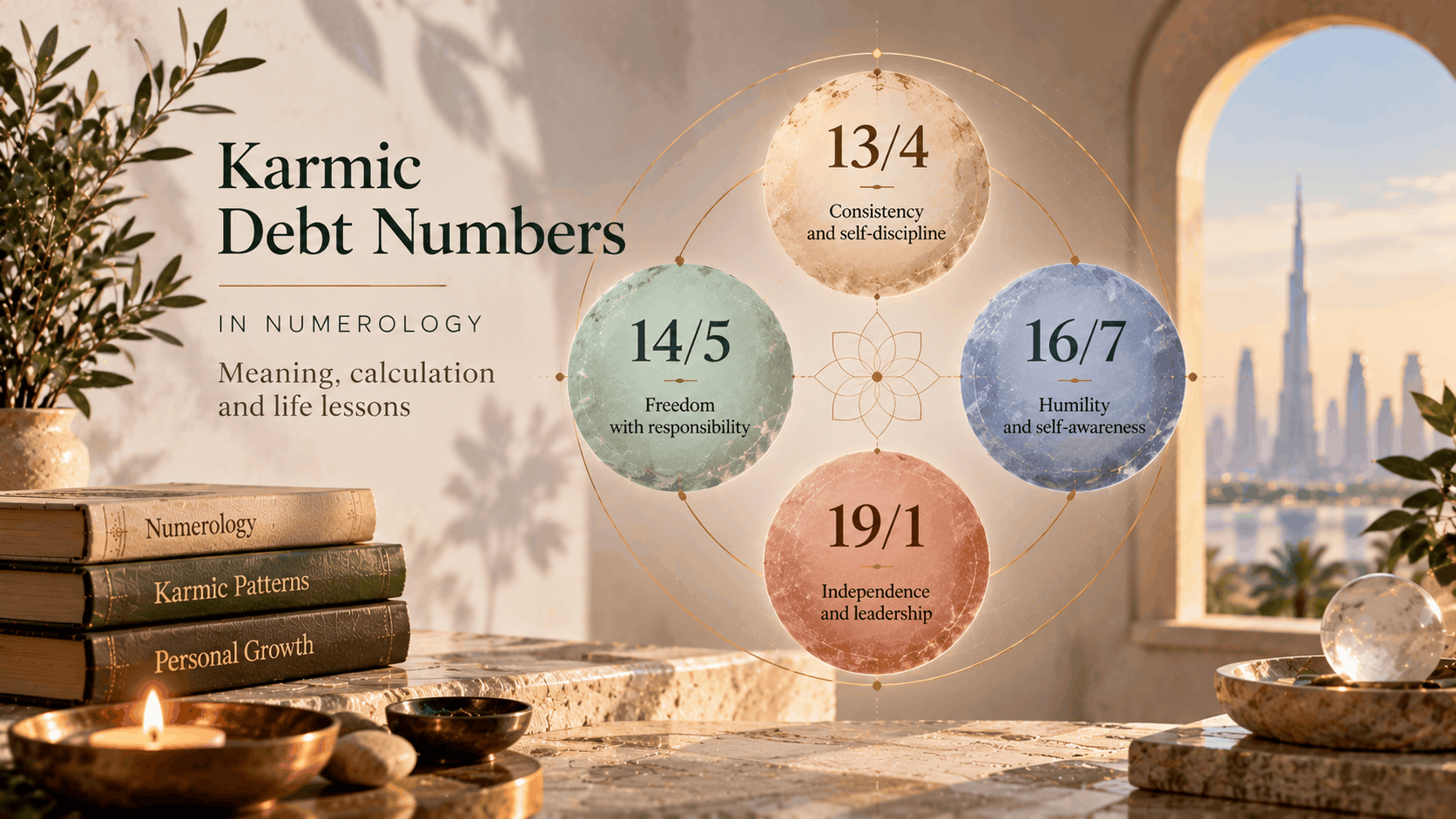
Karmic Debt Numbers are the compound numbers 13, 14, 16, and 19, which some Western numerology traditions associate with particular lessons in personal development. They are commonly written as 13/4, 14/5, 16/7, and 19/1, preserving both the original number and its reduced value.
The word “debt” belongs to a spiritual interpretation involving karma and reincarnation. It does not establish that someone committed wrongdoing in a past life or deserves present difficulties. Numerology is a belief system, and these interpretations are not scientifically validated explanations of life events.
Understanding the concept requires looking at three things: the compound number, how it was calculated, and where it appears in the chart.
The four numbers recognized in Hans Decoz’s description of Karmic Debt reduce as follows:
| Compound number | Reduction | Common notation |
| 13 | 1 + 3 = 4 | 13/4 |
| 14 | 1 + 4 = 5 | 14/5 |
| 16 | 1 + 6 = 7 | 16/7 |
| 19 | 1 + 9 = 10; 1 + 0 = 1 | 19/1 |
The slash records the relationship between the compound total and its final digit. It is not a division sign.
A result of 4 alone does not establish a 13/4 pattern. Both 13 and 31 reduce to 4, but their compound totals differ. Keeping the original working prevents the final digit from being given an unsupported label.
Descriptions vary between practitioners. Common Karmic Debt interpretations connect the four numbers with effort, freedom, humility, and independence. The examples below translate those symbolic themes into ordinary questions about behavior.
The 13/4 interpretation emphasizes sustained effort, organization, and completing responsibilities. Practitioners often discuss it through the tension between wanting results and maintaining the habits needed to achieve them.
A practical reflection might involve identifying unfinished commitments. Someone could choose one neglected task, divide it into manageable steps, and decide what completion looks like.
The point is not to work endlessly. Rest, realistic expectations, and asking for support can help someone follow through more effectively than simply increasing pressure.
The 14/5 theme concerns the use of freedom, adaptability, and moderation. Its reflective question is how to enjoy variety while remaining dependable.
Imagine someone who accepts every interesting invitation and repeatedly cancels earlier commitments. A useful response might be checking available time before agreeing to something new.
This theme does not require abandoning adventure or spontaneity. It invites consideration of consequences: who else is affected by a decision, what has already been promised, and which limits make flexibility sustainable?
The 16/7 interpretation commonly centers on pride, self-awareness, and reconsidering assumptions. Some traditional descriptions use dramatic language about the ego; a grounded reading can focus on openness to feedback.
For example, someone who dismisses suggestions could practice asking one clarifying question before defending their position. They might discover useful information without surrendering their judgment.
The number cannot establish that a relationship will collapse or that a setback is necessary. The constructive theme is willingness to learn and revise a mistaken view.
The 19/1 theme explores independence alongside respect for other people’s contributions. It can prompt reflection on the difference between taking initiative and insisting on doing everything alone.
A team leader might examine whether they delegate clearly, acknowledge assistance, and accept expertise outside their own specialty. Someone managing a personal project might ask for practical help earlier.
These are questions about present choices. They do not demonstrate that a person previously abused power or must struggle without support.
Practitioners may look for these compound numbers in the Birth Day, Life Path, Expression, Soul Urge, or Personality positions. Some also interpret them within cycle calculations.
The position matters. A birthday on the 14th is immediately identifiable as a day value; a name-based result requires a separate calculation using the relevant letters.
This context helps explain why identical numerology numbers can accompany different life paths. Matching digits do not make two complete charts identical, and individual circumstances remain different.
Ask for a precise label, such as “13/4 Life Path,” instead of an unexplained statement that you “have karmic debt.”
There is no single calculation that covers every chart position. First identify the number being calculated, then retain the relevant compound total before reducing it.
Consider a fictional birth date of March 4, 1995, using the component-based Life Path calculation explained by Decoz:
Under this method, the result is recorded as 13/4.
Adding every birth-date digit in one step produces 31, which also reduces to 4. This demonstrates why the calculation method matters when interpreting compound totals.
Keep a copy of the calculation and the method used. This makes later comparisons easier, especially when different numerology reports use different reduction rules or chart labels.
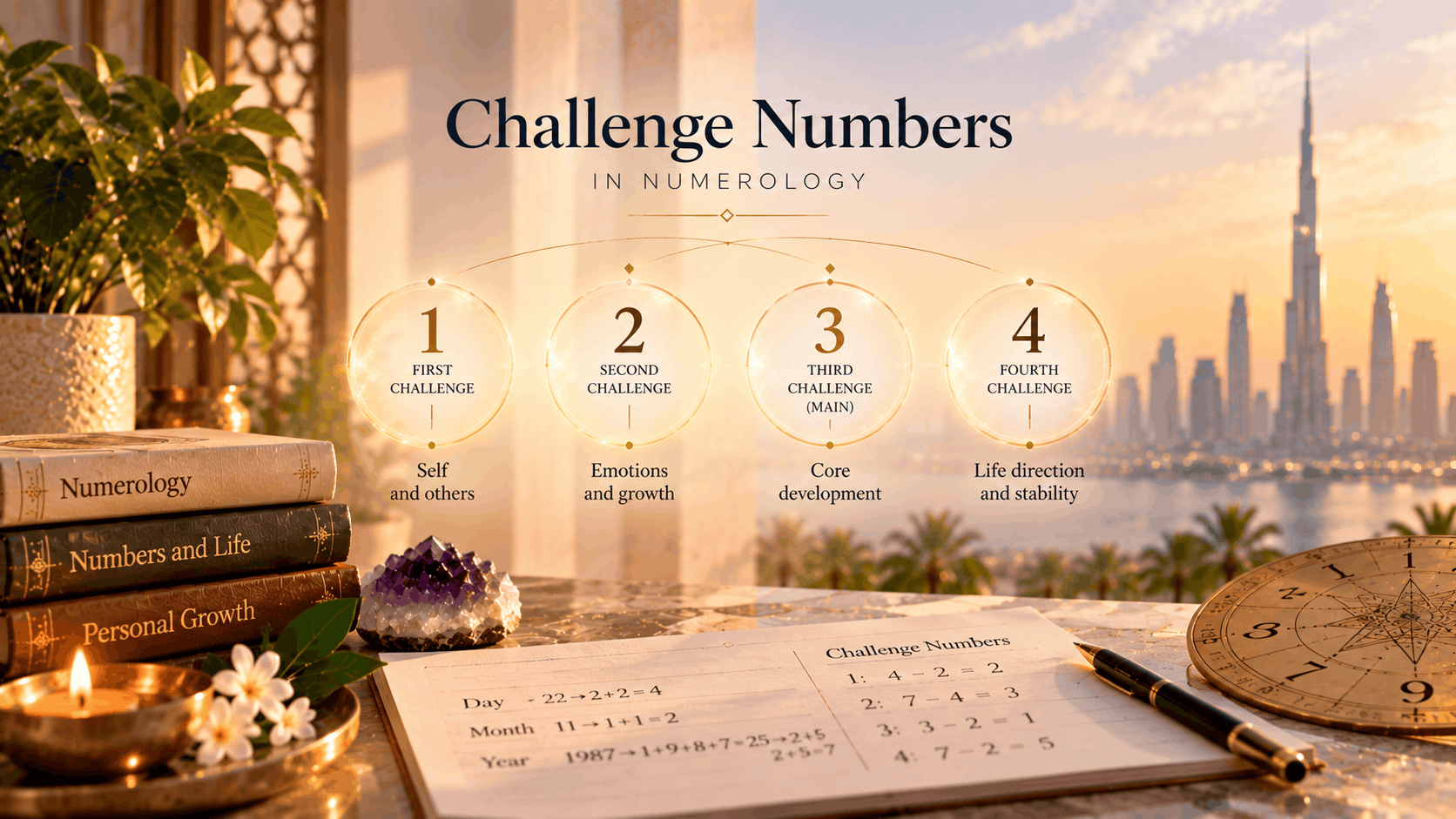
Check master-number handling too. Rules for retaining 11, 22, or 33 in a Life Path calculation differ from the full reduction used when calculating Challenge Numbers.
Seeing a number on a receipt, clock, or vehicle registration does not establish a Karmic Debt position in a birth chart.
Discussions of repeated numbers such as 111 and 777 concern numbers noticed in everyday settings. Identifying a chart-based Karmic Debt Number requires a specified calculation.
Keep those questions separate. “Why am I noticing this number?” and “Which total appears in my chart?” involve different claims and different information.
These terms can sound interchangeable, but they describe different parts of a Pythagorean numerology reading.
| Term | What practitioners examine |
| Karmic Debt Numbers | Particular compound totals: 13, 14, 16, and 19 |
| Karmic Lessons | Numerical values absent from the letters of the full birth name |
| Challenge Numbers | Differences between reduced birth-date components |
A missing letter value is not automatically a Karmic Debt Number. Likewise, a Challenge result of 4 does not demonstrate 13/4.
Ask a practitioner to identify which method supports the interpretation instead of treating every difficult-sounding label as the same thing.
A useful reading should show the starting information, intermediate totals, reduction rules, and exact chart position being discussed.
When speaking with a numerology consultant in Dubai, ask whether the interpretation comes from your birthday, complete birth date, birth name, or a particular cycle. For name-based calculations, confirm the spelling and transliteration used.
For example, if a report lists 16/7, ask to see where 16 appeared. The explanation should remain understandable without requiring you to accept a frightening prediction.
Choose a behavior you can examine rather than searching for evidence that every setback is karmic. A theme about responsibility might prompt clearer commitments; a theme about humility might encourage listening more carefully.
When using numerology to reflect on important decisions, compare the interpretation with your actual responsibilities, available information, and practical options. Consider observations that challenge the reading as well as those that seem to support it.
Progress is better assessed through changes in behavior than through promises that an invisible debt has disappeared.
No. Treating certain numbers as guarantees of bad luck reflects common myths about numerology. A number cannot establish that misfortune is inevitable.
Yes, within this framework, different chart positions may contain different qualifying totals. Each should be identified separately rather than combined into a general statement about someone’s character.
They are commonly classified as master numbers in Western numerology. That category is distinct from the Karmic Debt set of 13, 14, 16, and 19.
No. “Debt” is spiritual terminology here. It does not reveal a bank balance, predict borrowing, or establish that someone will experience financial difficulty.
There is no objectively verified calculation or deadline for this. Practitioners may discuss progress through symbolic lessons, but claims of definite clearance cannot be established by a numerical report.
Karmic Debt Numbers make more sense when the compound total stays connected to its calculation and chart position. The labels 13/4, 14/5, 16/7, and 19/1 describe a particular interpretive framework.
If you choose to engage with it, focus on questions that support thoughtful action. A responsible interpretation should leave you with greater understanding of the method and room to make your own choices.
 " alt="What Does a Hidden Passion Number Reveal in Numerology?">

 " alt="How Are Challenge Numbers Calculated in Numerology?">
 " alt="What Is a Numerology Maturity Number and When Does It Become Relevant?">
 " alt="What Is Ayanamsha and Why Can It Change a Birth-Chart Reading?">

