

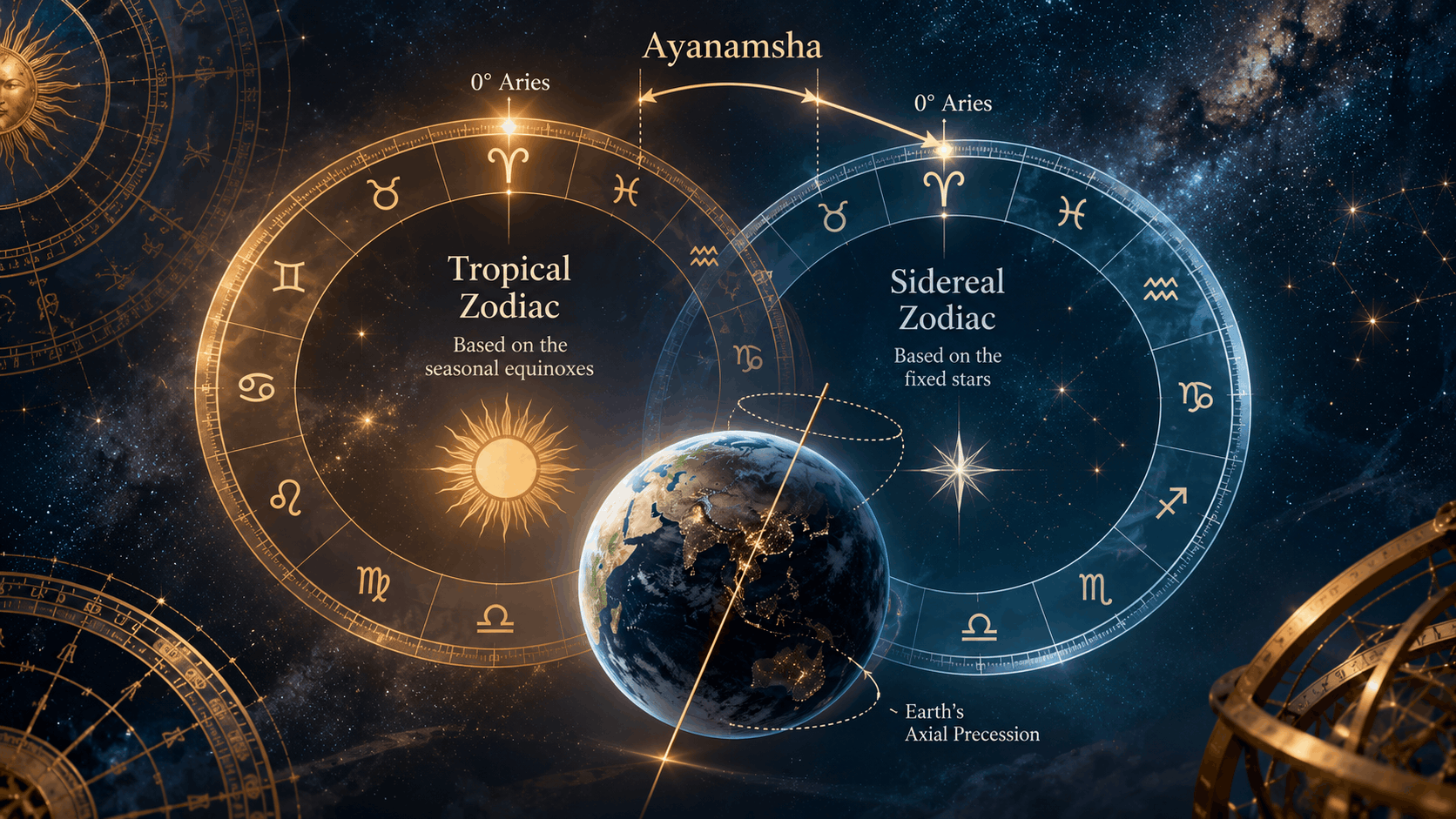
Ayanamsha is the angular difference between the tropical zodiac and the sidereal zodiac. In simple terms, it represents the gap between the zodiac used by Western tropical astrology and the star-based zodiac commonly used in Vedic astrology.
This difference exists because the Earth’s axis slowly changes its orientation over time. As a result, the position of the equinoxes gradually moves against the background of fixed stars. Astrology systems use different reference points to calculate the zodiac, which can place planets at different degrees or even in different signs.
Ayanamsha is important because a small change in planetary degree can affect the ascendant, Moon sign, nakshatra, planetary dignity, house placement, divisional charts, and dasha interpretation. A thoughtful astrology reading should be understood within its limitations rather than treated as a fixed result produced by software alone.
The word Ayanamsha refers to the difference or “arc” between two zodiac reference systems. One system is aligned with the seasonal equinoxes, while the other is aligned more closely with the observable relationship between the planets and the stars.
The tropical zodiac begins with the vernal equinox. The first degree of Aries is fixed to that seasonal reference point, even though the background stars gradually shift because of the precession of the equinoxes.
The sidereal zodiac attempts to account for this movement by using a reference connected with the stars. Vedic astrology generally uses a sidereal zodiac, although different astrologers may use different ayanamsha values.
The difference is measured in degrees. When that value is subtracted from a tropical planetary position, the result is used to calculate a sidereal position. The calculation may move a planet backward by several degrees and, in some cases, into the previous zodiac sign.
The Earth does not rotate in a completely fixed orientation. Its axis slowly traces a circular movement, similar to the gradual wobble of a spinning top. This process is known as the precession of the equinoxes.
Because of this movement, the equinox points slowly shift in relation to the stars. The zodiac signs used in tropical astrology remain connected with the seasons, while the sidereal zodiac attempts to maintain a closer relationship with the stellar background.
This creates a difference between the two systems. A person may have a tropical Sun in one sign and a sidereal Sun in the previous sign. Neither calculation is necessarily a software error. They are based on different reference frameworks.
Ayanamsha provides the mathematical adjustment required to move between these systems. The exact result depends on the chosen ayanamsha and the planetary degree at the time of birth.
The tropical zodiac is based on the seasonal cycle. Its starting point is linked to the vernal equinox, and the zodiac signs remain fixed in relation to the seasons.
The sidereal zodiac is based on a stellar reference. It accounts for the gradual movement of the equinoxes and usually places planets several degrees earlier than the tropical system.
This difference can affect:
A person who identifies strongly with a tropical Sun sign may receive a different sign placement in a sidereal chart. This does not mean that one system has to be dismissed. It means that the chart must be interpreted according to the tradition and calculation method being used.
Mixing a tropical sign placement with a sidereal dasha or a different ayanamsha can create confusion. The astrologer should use one consistent framework throughout the reading.
There is no single ayanamsha value accepted by every astrologer. Different schools use different reference stars, calculations, and historical assumptions.
Some commonly discussed systems include:
Lahiri, also called Chitrapaksha, is widely used in Indian Vedic astrology. Many astrology software programs and practitioners select it as the default sidereal setting.
Raman Ayanamsha follows the approach associated with B. V. Raman. It produces slightly different planetary positions from Lahiri and may affect planets close to sign or nakshatra boundaries.
KP astrology uses an ayanamsha associated with the Krishnamurti Paddhati system. Its calculations are often used with KP house cusps, sub-lords, and timing techniques.
Yukteswar Ayanamsha follows another reference framework and may produce a different sidereal position from Lahiri or Raman.
Fagan-Bradley is commonly associated with Western sidereal astrology. It uses a different reference from several Indian systems.
These systems may differ by a small number of degrees, but that difference can become significant when a planet is near a boundary.
Ayanamsha can shift a planet backward by several degrees. If the tropical position is close to the beginning of a sign, the sidereal calculation may place it in the previous sign.
For example, a planet near the first few degrees of Leo in a tropical chart may fall in Cancer in a sidereal chart, depending on the ayanamsha used. A planet in the middle of a sign may remain in the same sign under several systems.
Sign changes can affect:
The change does not mean that the planet has physically moved. It reflects the reference system used to describe its position.
The ascendant moves quickly through the zodiac. Because of this, it is particularly sensitive to calculation differences and birth-time accuracy.
If the ascendant is near the end or beginning of a sign, a different ayanamsha may move it into another sign. This can change the ascendant lord, the house sequence, house lordships, planetary relationships, and the entire structure of the horoscope.
Even when the ascendant remains in the same sign, its exact degree may change. This can influence house cusps, divisional charts, planetary aspects, and the interpretation of planets close to house boundaries.
This is why an astrologer should use the exact birth time and clearly state the ayanamsha and house system used. People who are unsure about their birth details can review how uncertain birth time affects astrology before requesting a detailed reading.
The Moon moves quickly, so its sign and nakshatra can be sensitive to even small degree differences. If the Moon is near a sign boundary, one ayanamsha may place it in one sign while another places it in the previous sign.
A change in the Moon’s nakshatra may also affect the interpretation of emotional patterns, mental tendencies, relationships, and the starting point of the Vimshottari Dasha system.
Nakshatras are divided into four padas. If the Moon is near a pada boundary, a different calculation may change the pada even when the nakshatra itself remains the same.
This can alter the beginning dasha balance and the timing sequence used by the astrologer. It may also affect divisional charts that depend on precise planetary degrees.
The closer the Moon is to a boundary, the more carefully the astrologer should compare the chart settings.
If Ayanamsha changes the ascendant sign, it can change the complete house sequence and therefore the house lords. This can have a major effect on the interpretation of career, marriage, finances, education, health, property, and other life areas.
If only a planet changes sign while the ascendant remains the same, the house lords may not change, but the planet’s dignity, aspects, conjunctions, and yoga formation may be affected.
Some yogas depend on planets owning or occupying particular houses. A planet moving across a sign boundary may therefore create or remove a specific combination under one calculation method.
This does not mean that every chart must be interpreted through multiple systems. The astrologer should select a consistent method and explain why it is being used.
Two astrologers may use different ayanamsha settings, house systems, chart calculation software, or interpretive traditions. They may also use different approaches to divisional charts, dashas, aspects, and planetary strength.
A planet close to a sign boundary may appear in different signs under different settings. A planet near a house cusp may also be assigned to a different house.
This is one reason different astrologers can reach different interpretations even when they receive the same birth details. The difference may come from methodology rather than carelessness.
A responsible consultation should identify the ayanamsha used, explain the relevant chart placements, and avoid presenting one calculation as the only possible tradition.
There is no universal answer for every person. The most appropriate choice depends on the astrological tradition, school, software, and techniques being used.
Lahiri or Chitrapaksha is a common choice for mainstream Vedic astrology. KP practitioners may use the ayanamsha associated with the Krishnamurti system. Other astrologers may prefer Raman, Yukteswar, or another method based on their training.
The important principles are consistency and transparency:
Switching between ayanamshas simply to obtain a preferred result can make the reading unreliable.
Yes. If Ayanamsha changes the Moon’s nakshatra or the exact degree within the nakshatra, it can affect the balance of the first planetary dasha at birth.
The Vimshottari Dasha system begins according to the Moon’s nakshatra and the portion of that nakshatra remaining at birth. A difference in lunar degree can therefore change the starting balance and shift the estimated timing of later planetary periods.
In some cases, the overall dasha sequence remains the same but the starting balance changes slightly. In other cases, a boundary change can create a more noticeable difference.
Timing should not be judged from Ayanamsha alone. The birth chart, divisional charts, transits, planetary strength, and real-life events must also be considered.
A professional astrologer should explain which zodiac, ayanamsha, house system, and timing techniques are being used. Clients should be able to understand why their chart may look different from one generated by another website or astrologer.
The reading should focus on meaningful patterns rather than creating anxiety over small technical differences. If a planet is far from a boundary, a minor ayanamsha difference may have little practical effect. If the ascendant, Moon, or a key planet is close to a boundary, the astrologer may compare possible interpretations.
An online or in-person session can both be useful when the chart data and calculation settings are handled accurately. The choice of consultation format does not change the underlying importance of using a consistent method, as explained in discussions of online and face-to-face astrology consultations.
Ayanamsha is the angular difference between the tropical and sidereal zodiacs. It is used to account for the precession of the equinoxes when calculating sidereal planetary positions.
Different astrological schools use different reference points, calculations, and traditions. Lahiri, Raman, KP, Yukteswar, and Fagan-Bradley are examples of different ayanamsha systems.
It can, particularly when the Moon is close to a sign boundary. A change in the Moon’s degree may also affect its nakshatra, pada, and dasha timing.
It can change the ascendant if the ascendant degree is close to the beginning or end of a zodiac sign. This may alter house lordships and the structure of the chart.
Lahiri or Chitrapaksha is widely used, but the most appropriate choice depends on the astrologer’s tradition and techniques. Consistency is more important than changing settings to obtain a preferred result.
Ayanamsha is an important calculation factor in sidereal astrology because it determines how planetary positions are measured against the zodiac. Its effect may be small when planets are comfortably placed within signs, but it can become significant when the ascendant, Moon, nakshatra, or key planets sit near boundaries.
The choice of ayanamsha can influence sign placement, house lords, yogas, divisional charts, and dasha timing. It does not make a birth chart meaningless when another system produces different results. It shows that different astrological traditions use different reference points.
Before a consultation, prepare accurate birth details and understand the calculation method being used. Guidance on preparing for an astrology consultation in Dubai can help make the discussion more focused.
A clear reading should state the ayanamsha, use it consistently, explain boundary-sensitive placements, and interpret the complete horoscope rather than relying on one technical difference.


 " alt="What Does a Hidden Passion Number Reveal in Numerology?">

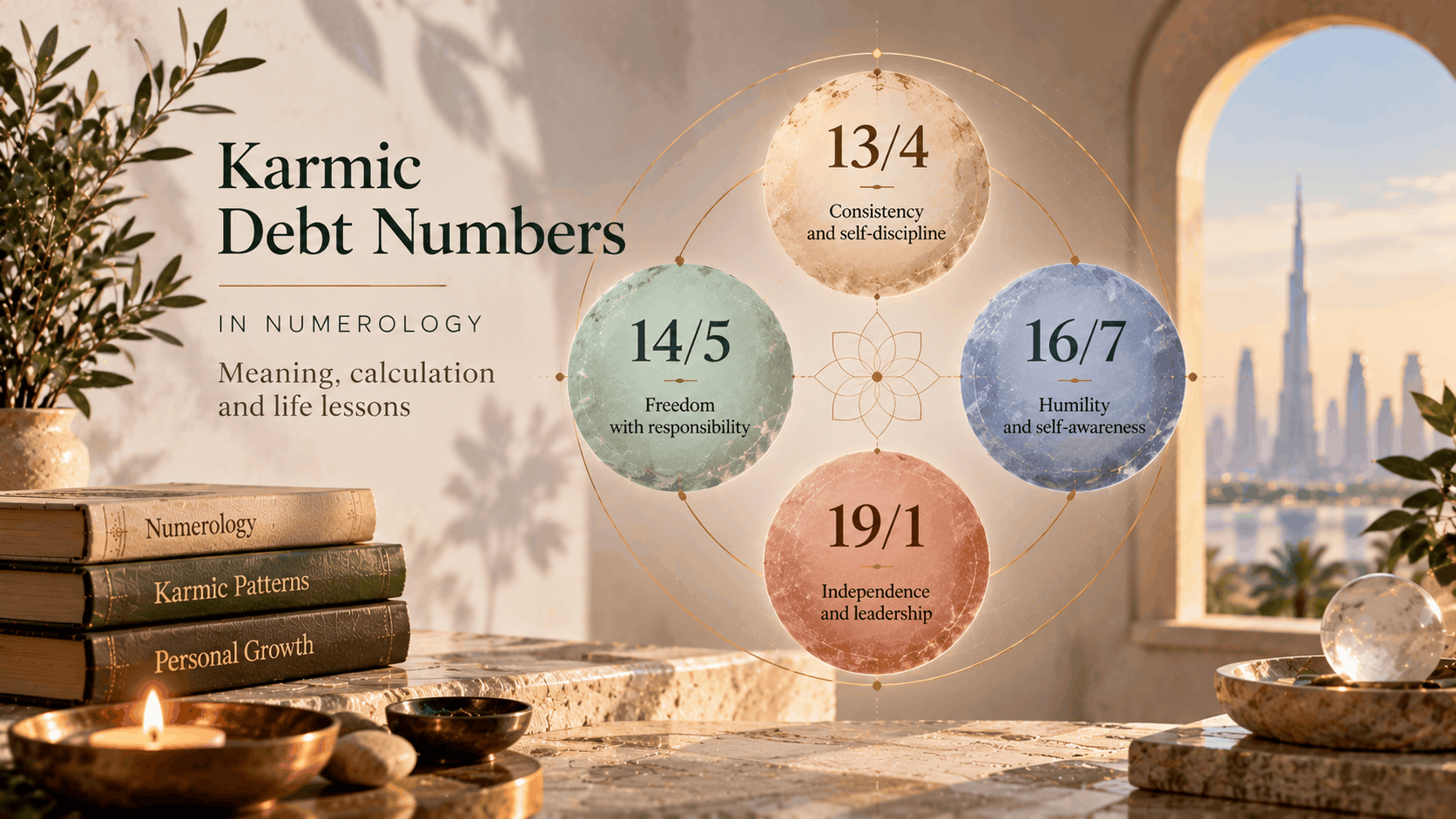 " alt="What Are Karmic Debt Numbers in Numerology?">
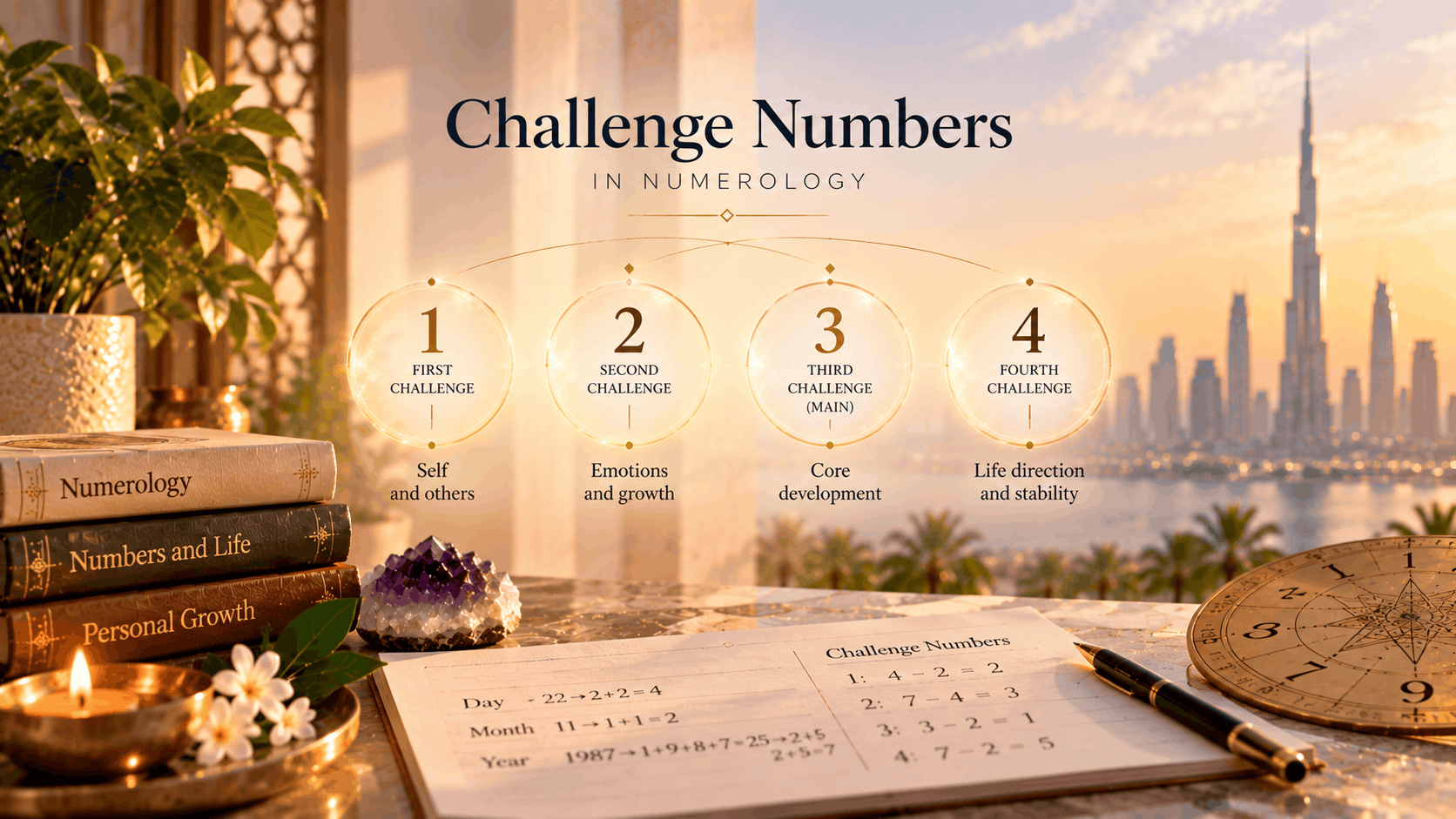 " alt="How Are Challenge Numbers Calculated in Numerology?">
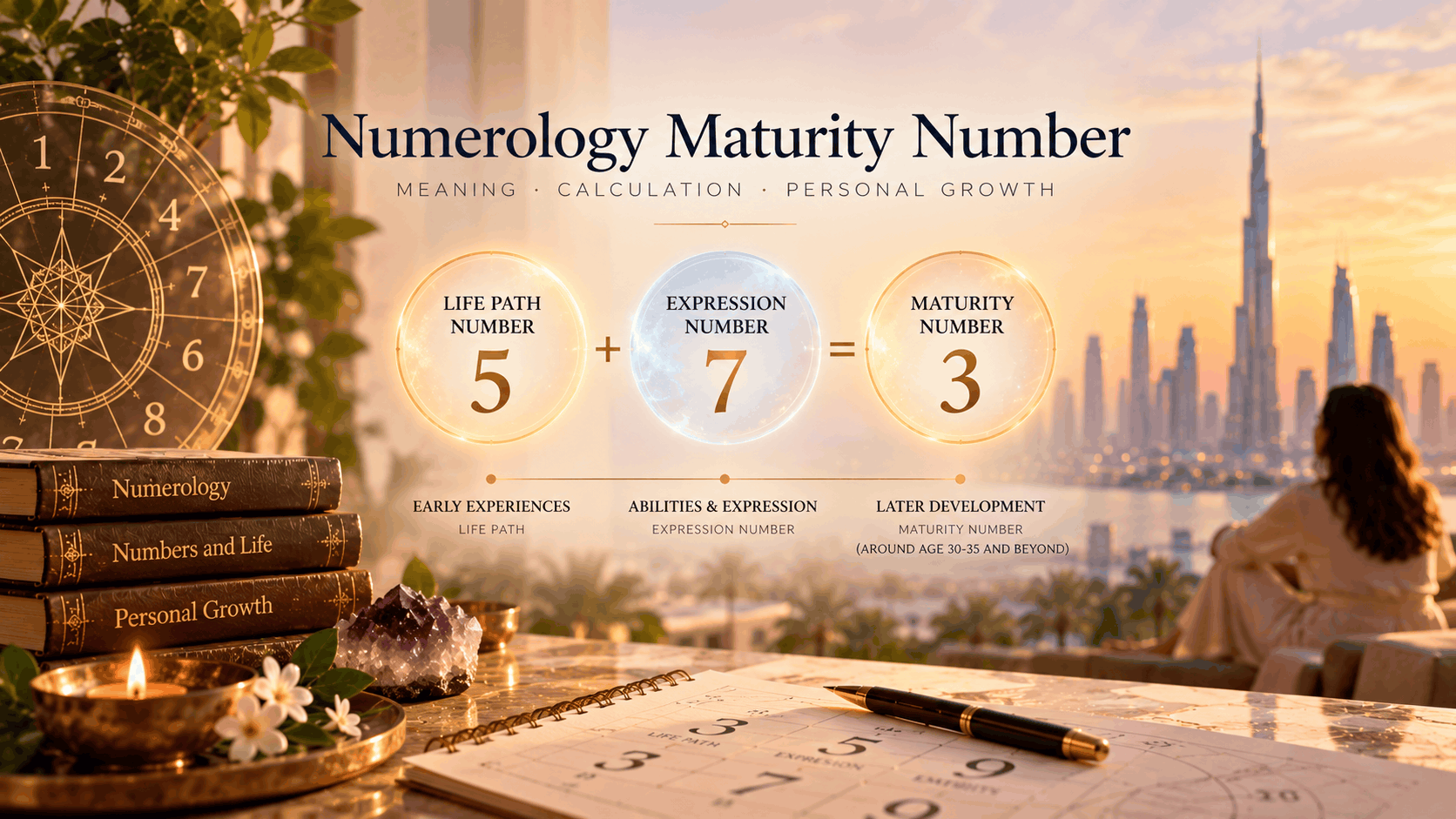 " alt="What Is a Numerology Maturity Number and When Does It Become Relevant?">