

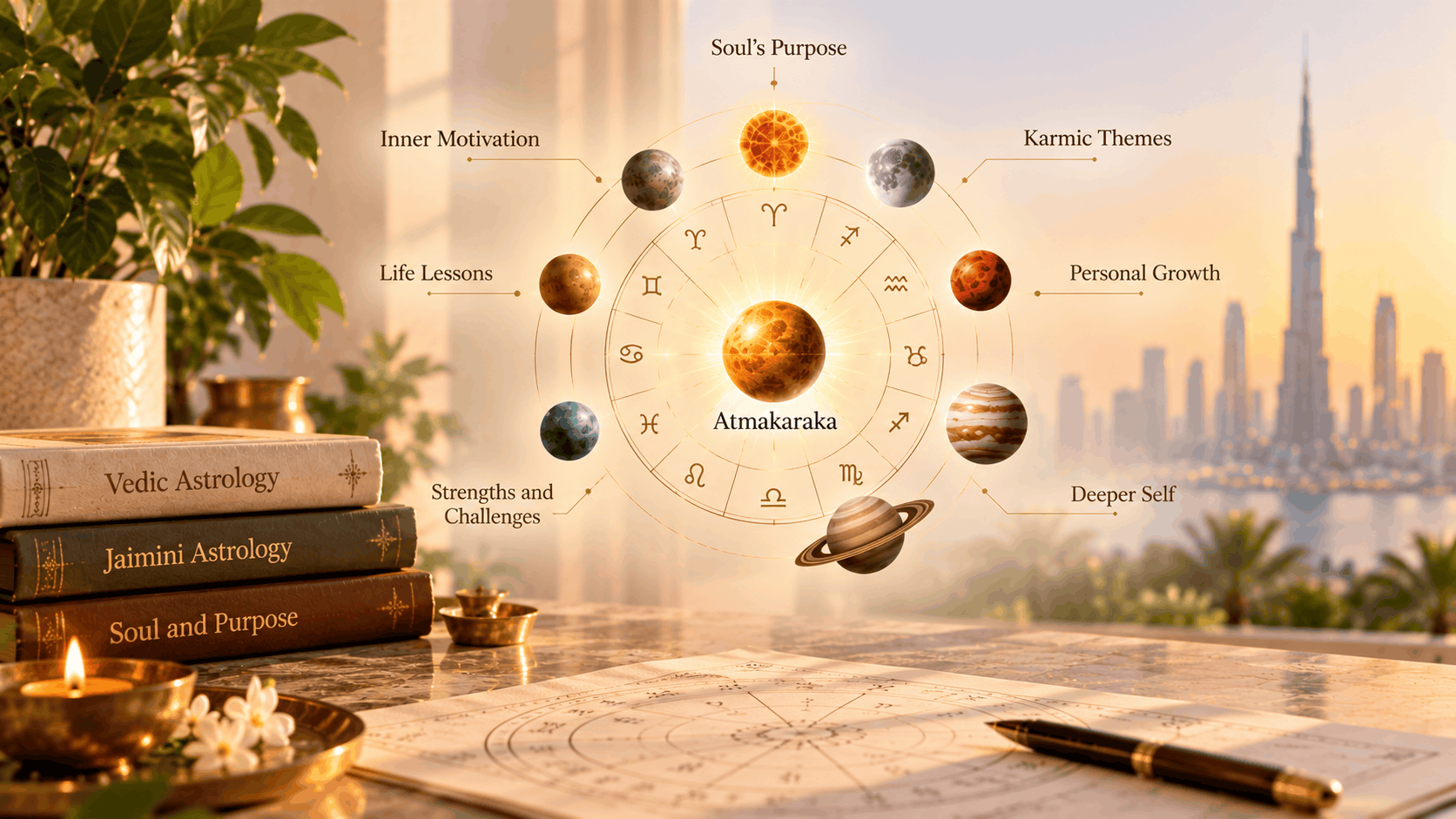
Atmakaraka is an important concept in Jaimini Vedic astrology. The word is formed from “Atma,” meaning self or soul, and “Karaka,” meaning significator. In a birth chart, the Atmakaraka is traditionally considered the planet that represents a person’s deepest learning themes, inner motivations, personal struggles, and path of development.
It is identified by comparing the degrees of the planets in the birth chart. The planet with the highest degree within its sign usually becomes the Chara Atmakaraka. Some astrologers include Rahu using a different calculation method, while others work with the seven classical planets.
Atmakaraka is not a simple indicator of success, personality, or fixed destiny. It needs to be interpreted with the ascendant, Moon, house lords, divisional charts, planetary periods, and other Jaimini factors. A detailed Vedic astrology consultation in Dubai can place Atmakaraka within the context of the complete horoscope.
Atmakaraka is often described as the significator of the self. It can point to the areas of life where a person experiences strong internal pressure to grow, understand, mature, or become more aware.
It may be connected with:
The planet does not necessarily describe what a person consciously wants. It may show themes that continue to appear until they are understood more clearly.
For example, a person with Saturn as Atmakaraka may repeatedly encounter lessons involving patience, responsibility, delay, structure, or endurance. Someone with Venus as Atmakaraka may explore relationships, values, beauty, comfort, attachment, or emotional balance.
These are broad themes rather than fixed predictions.
In the commonly used seven-planet system, the degrees of the Sun, Moon, Mars, Mercury, Jupiter, Venus, and Saturn are compared. The planet with the highest degree in its sign becomes the Atmakaraka.
Suppose the planetary degrees are:
In this example, Jupiter has the highest degree and would become the Atmakaraka.
The calculation should be based on the planetary degree within the sign, not simply the total longitude from zero degrees Aries. The method used for Rahu also differs between astrologers because Rahu moves retrograde by nature.
Accurate birth details are important. If the birth time is uncertain, the planetary degrees may still be usable in some cases, but the house positions, ascendant, and divisional charts may become less reliable.
The ascendant lord represents the planet ruling the rising sign. It is commonly studied for physical identity, approach to life, vitality, and general direction.
Atmakaraka is identified through planetary degree and is interpreted as a deeper significator of inner development. The two planets may be the same, but they do not have the same role.
The ascendant lord often shows how a person operates in the visible world. Atmakaraka may indicate the internal themes behind that behavior. For example, the ascendant lord may show a person’s professional style, while Atmakaraka may reveal why certain responsibilities or conflicts repeatedly affect their sense of identity.
Both should be interpreted together. Neither planet should be treated as a complete summary of the person’s character.
People interested in the self-understanding side of astrology may also explore birth-chart analysis for greater self-awareness.
The Atmakaraka planet may show the qualities a person must learn to handle with greater awareness. Its natural character, sign, house, aspects, conjunctions, and dignity all influence the interpretation.
The planet may reveal:
The Atmakaraka is not always connected with comfortable experiences. Sometimes it represents the area where the person must develop patience, humility, courage, emotional control, discipline, or discernment.
For example, Mars as Atmakaraka may bring lessons involving anger, competition, independence, conflict, courage, or the responsible use of power. Mercury may create learning around communication, logic, adaptability, business, or indecision. The final meaning depends on the condition of the planet in the chart.
The Sun may indicate lessons involving confidence, authority, leadership, independence, recognition, and the relationship with father figures or institutions.
The person may need to develop healthy self-respect without becoming overly attached to praise or control. Challenges may arise when pride, ego, or the need for approval becomes stronger than self-awareness.
The Moon may connect the life path with emotions, care, family, mental habits, security, and adaptability.
The person may learn how to manage sensitivity, changing moods, emotional dependence, and the desire for reassurance. Developing emotional stability without suppressing feeling may become important.
Mars may bring lessons involving courage, action, competition, anger, physical energy, independence, and conflict.
The person may need to learn how to act decisively without becoming aggressive or impulsive. Responsible use of strength and the ability to cooperate may be central themes.
Mercury may emphasize communication, learning, analysis, business, negotiation, writing, technology, and adaptability.
The person may need to develop clarity, consistency, and thoughtful communication. Scattered attention, overthinking, nervousness, or excessive calculation may require management.
Jupiter may connect the individual’s growth with knowledge, teaching, ethics, faith, guidance, children, law, or higher learning.
The person may need to balance wisdom with humility. Overconfidence in personal beliefs or dependence on authority may become an area for reflection.
Venus may bring lessons involving relationships, affection, beauty, comfort, pleasure, values, art, and material attachment.
The person may learn the difference between genuine connection and dependence on approval or luxury. Emotional balance and healthy boundaries may become important.
Saturn may emphasize discipline, patience, responsibility, service, limitations, work, delay, and long-term effort.
The person may face situations that require endurance and maturity. Although progress may feel slow, the deeper lesson may involve accepting responsibility and building something stable over time.
Some Jaimini astrologers include Rahu as a Chara Atmakaraka using a special degree calculation. Rahu may indicate lessons involving ambition, unconventional paths, foreign environments, strong desires, uncertainty, technology, or breaking from familiar expectations.
Because Rahu’s calculation and interpretation differ between traditions, the astrologer should clearly explain the method being used.
Karakamsha is usually discussed in relation to the Atmakaraka’s position in the Navamsa chart. The sign occupied by Atmakaraka in the Navamsa may be treated as the Karakamsha sign.
Jaimini astrologers may study the Karakamsha chart to understand deeper tendencies, values, abilities, spiritual interests, and the direction of personal development. Planets placed in or aspecting relevant positions from Karakamsha may add further meaning.
The Karakamsha analysis should not be separated from the main birth chart. The Rashi chart provides the primary context, while the Navamsa offers another layer of interpretation.
The Atmakaraka’s strength, sign, house, conjunctions, and relationship with other planets should all be reviewed before reaching a conclusion. A single placement is rarely enough to explain a complete life path.
Atmakaraka is sometimes associated with repeated challenges because it represents areas where the person is expected to develop awareness. These experiences may involve relationships, career, family duties, authority, independence, health routines, finances, or emotional patterns.
The purpose is not to suggest that every difficulty is predetermined. It is better understood as a symbolic framework for identifying patterns and areas where conscious action may help.
For example, if Atmakaraka is connected with partnership houses, relationships may become a major area of learning. If it is connected with career houses, responsibility and professional identity may play a central role. If it is linked with the eighth or twelfth houses, transformation, privacy, research, uncertainty, or spiritual reflection may become more prominent themes.
The interpretation should remain balanced and practical.
Atmakaraka alone cannot select a career. However, it may show qualities that a person is repeatedly encouraged to develop through work and responsibility.
For example:
These possibilities must be compared with the tenth house, tenth-house lord, Sun, Mercury, Dashamsha chart, and active planetary periods.
Astrology can offer perspective, but education, skills, experience, market conditions, and personal decisions remain essential when choosing a career.
Atmakaraka themes may become more noticeable during the dasha or sub-period of the Atmakaraka planet. The person may face decisions, responsibilities, changes, or self-reflection connected with the planet’s houses and placement.
Transits over the Atmakaraka, its sign, Karakamsha, or relevant houses may also bring attention to these themes. The timing may coincide with career shifts, relationship changes, relocation, increased responsibility, or a period of personal questioning.
However, Atmakaraka does not guarantee one specific event. Timing should be judged using the complete dasha sequence, transits, house lords, divisional charts, and current circumstances.
People going through a major transition may find astrological guidance during life changes useful when placed alongside practical planning.
No. Atmakaraka is not automatically a negative planet. It may represent a significant area of growth, but growth can also come through talent, meaningful relationships, responsibility, achievement, or service.
A well-placed Atmakaraka may help a person develop its qualities with greater confidence. A challenged Atmakaraka may make the lessons more visible or demanding.
The planet’s dignity, house placement, aspects, conjunctions, strength, and dasha all matter. A strong Saturn may support patience and achievement, while a weak Saturn may create fear or discouragement. A strong Venus may support creativity and relationship understanding, while a difficult Venus may create attachment or dissatisfaction.
The interpretation should identify both the challenge and the constructive way to work with it.
An Atmakaraka reading may be useful when someone wants to understand repeated patterns, personal motivations, emotional attachments, career responsibilities, relationship lessons, or periods of major inner change.
Provide accurate birth details and ask the astrologer to explain:
A useful consultation should create clarity rather than fear. Astrology should support reflection and informed decisions, not remove personal choice.
Before booking a session, reviewing how an astrology consultation can provide clarity may help set realistic expectations.
Atmakaraka is the planet with the highest degree within its sign in a birth chart, according to the chosen Jaimini calculation method. It is interpreted as a significator of deep personal development and life lessons.
It is important in Jaimini astrology, but it should not be treated as the only important planet. The ascendant, Moon, house lords, yogas, divisional charts, dashas, and transits must also be studied.
Atmakaraka does not independently predict fixed events. It highlights themes and areas of growth, while timing techniques and the complete chart are needed for further interpretation.
Atmakaraka is the planet selected by degree. Karakamsha generally refers to the sign occupied by that planet in the Navamsa chart and the analysis built around it.
It may indicate qualities and life lessons connected with career or relationships, but it cannot determine either area alone. Relevant houses, planets, divisional charts, and planetary periods must be assessed.
Atmakaraka offers a way to explore the deeper themes behind a person’s experiences. It may show the qualities a person is encouraged to develop, the attachments that require awareness, and the responsibilities that shape personal maturity.
Its interpretation depends on the planet, sign, house, aspects, conjunctions, Navamsa placement, Karakamsha, planetary strength, dashas, and transits. No Atmakaraka placement should be treated as a guaranteed prediction or a fixed label.
When studied within the complete birth chart, Atmakaraka can provide a thoughtful perspective on motivation, recurring patterns, personal challenges, and long-term growth.


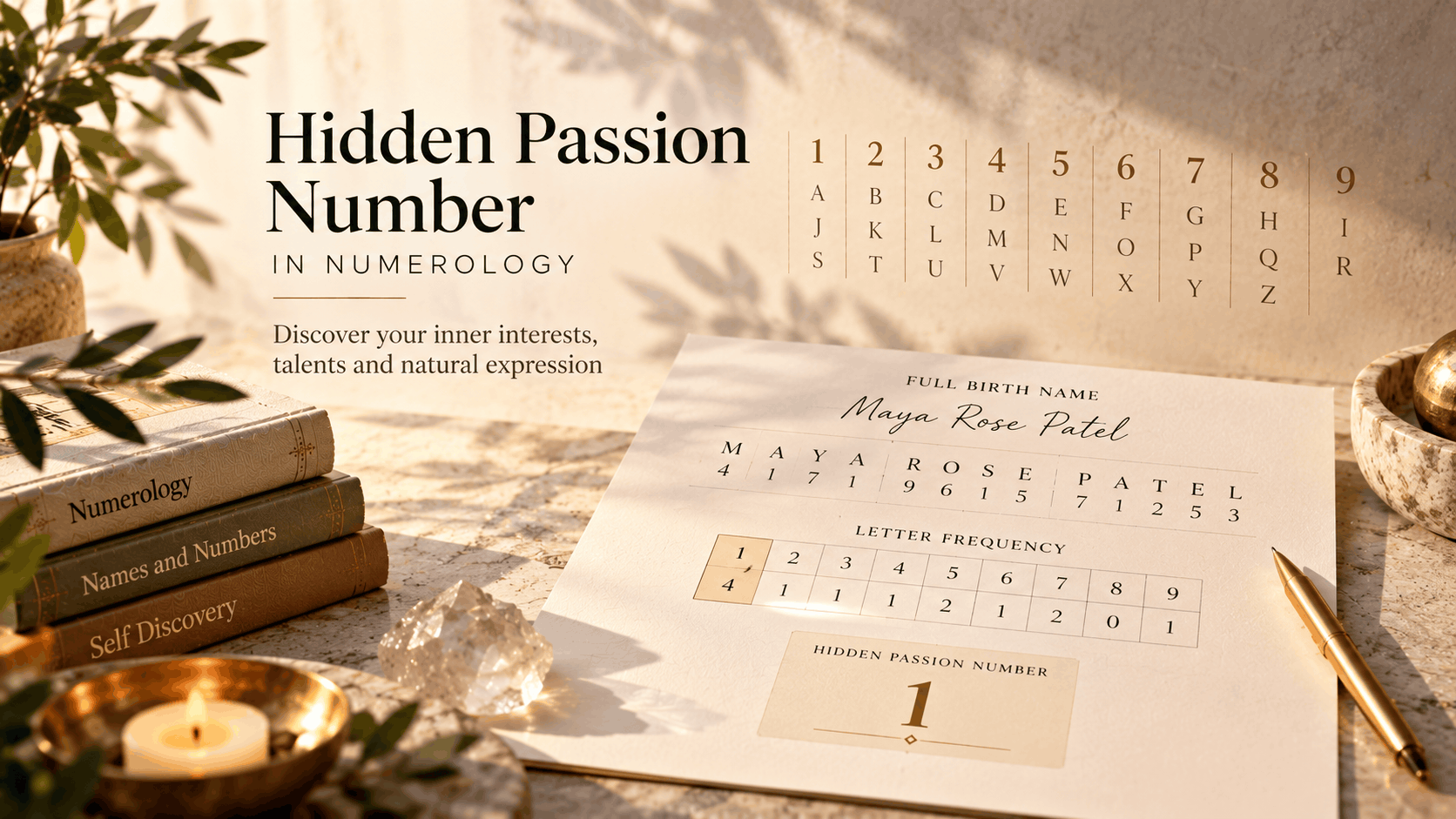 " alt="What Does a Hidden Passion Number Reveal in Numerology?">

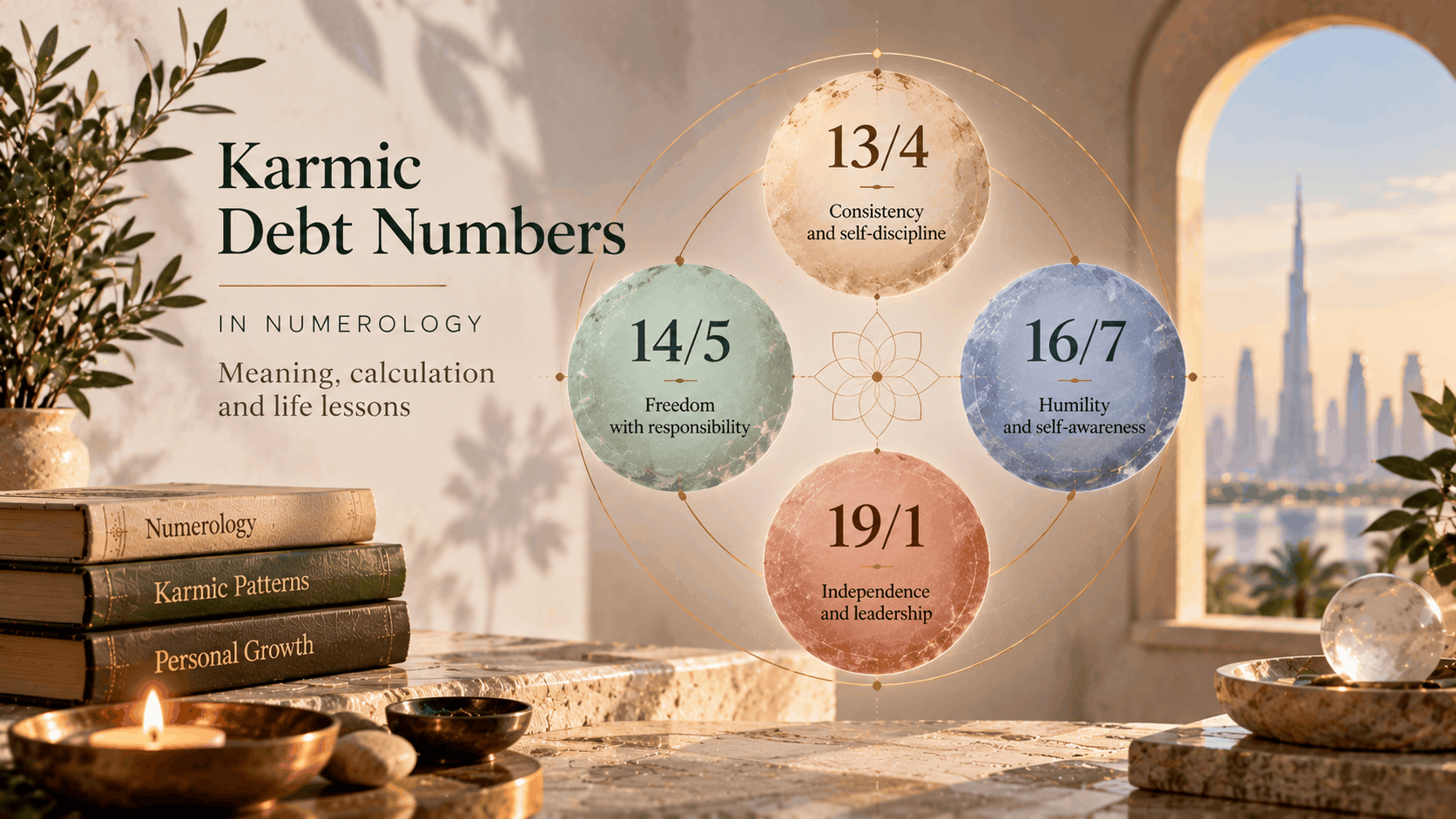 " alt="What Are Karmic Debt Numbers in Numerology?">
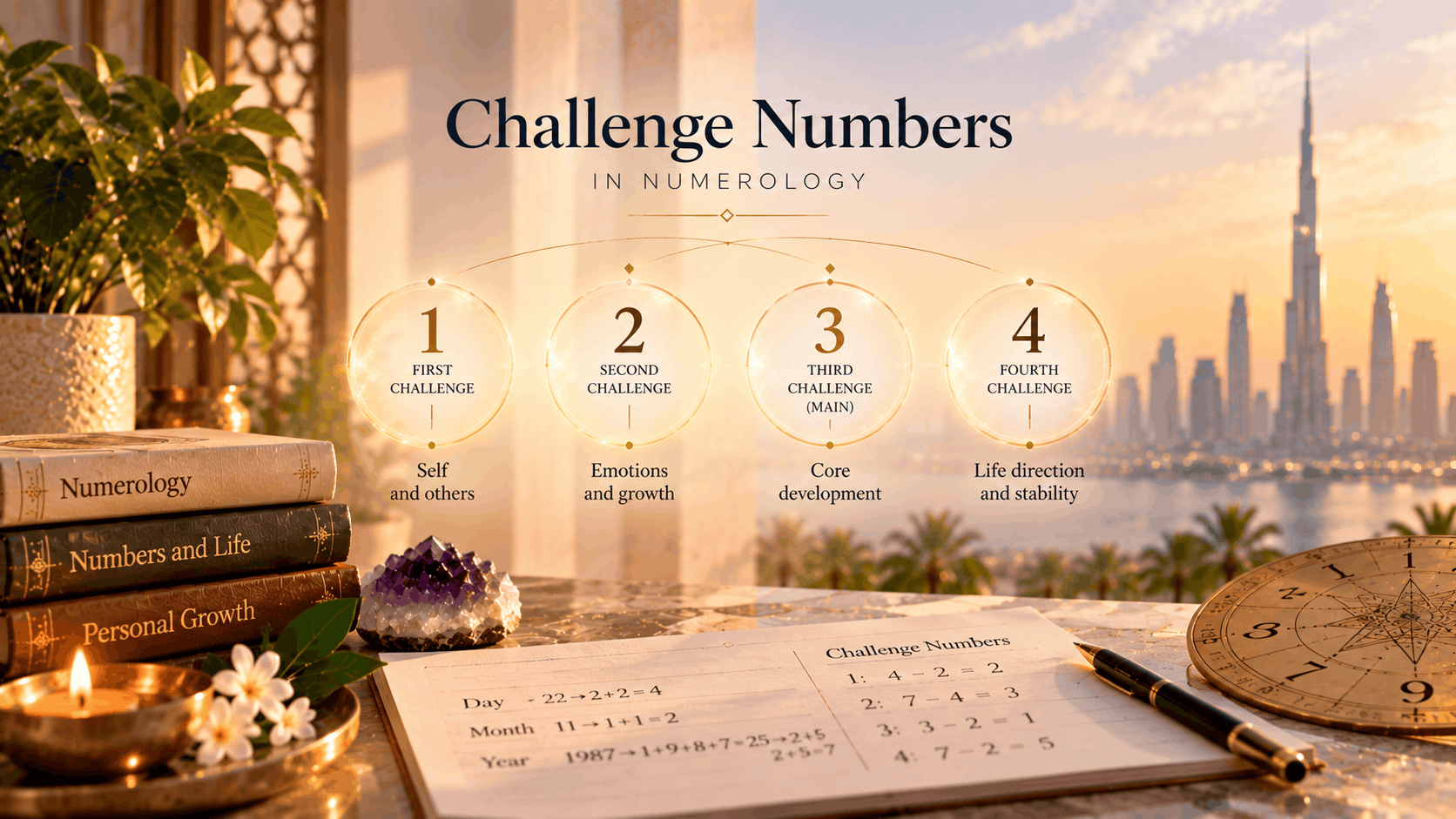 " alt="How Are Challenge Numbers Calculated in Numerology?">
 " alt="What Is a Numerology Maturity Number and When Does It Become Relevant?">