

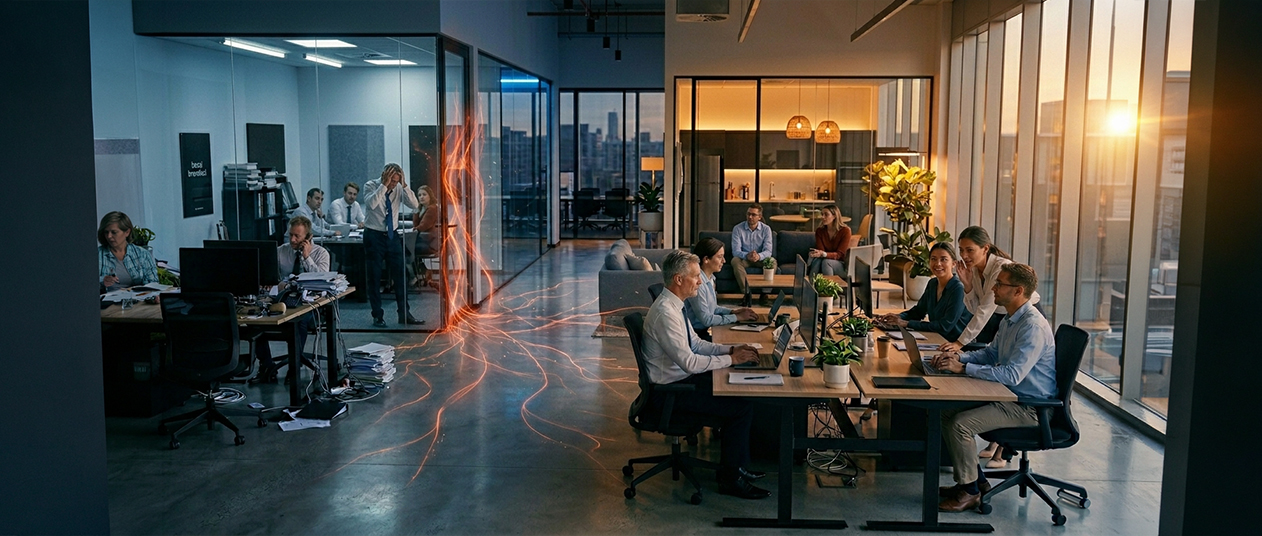
Some offices immediately feel comfortable to work in.
People enter the space feeling focused, conversations happen naturally, and the overall atmosphere feels lighter even during stressful workdays. With employees remaining mentally present for longer periods, meetings feel smoother, and the office environment supports concentration rather than exhausting it.
At the same time, there are workplaces that constantly feel mentally tiring despite having modern interiors, capable teams, and strong operational systems.
The difference is something many professionals notice but rarely discuss openly.
Certain offices feel calm and productive.
Others quietly drain energy throughout the day.
In cities like Dubai, where professionals already operate under continuous pressure, the workplace atmosphere influences daily emotional wellbeing much more than most businesses initially realise.
Most companies associate workplace fatigue entirely with deadlines, targets, and workload pressure.
While these factors certainly matter, the environment itself also affects how people emotionally experience their workday.
Some offices slowly create:
Employees may not immediately recognise the environment as the problem because modern corporate culture has deeply normalised workplace stress.
However, when people spend long hours inside spaces that constantly feel visually crowded, emotionally restrictive, or mentally overstimulating, exhaustion gradually increases over time.
This is one reason businesses are today becoming more conscious about workspace atmosphere instead of focusing only on productivity metrics.
People emotionally respond to spaces, whether they consciously realise it or not.
The atmosphere inside an office affects:
Some workspaces naturally feel:
Other environments feel:
Interestingly, this feeling often has very little to do with how expensive the office looks.
A luxury workspace can still feel mentally exhausting if the environment itself lacks balance.
One of the most common problems in modern offices is excessive visual stimulation.
Many workplaces unknowingly create mental pressure through:
Over time, employees adapt to these environments and stop noticing how emotionally tiring the workspace actually feels.
In many offices, even short meetings begin feeling unusually exhausting by the second half of the day.
Some teams unconsciously avoid spending extra time inside the workspace after office hours because the atmosphere already feels mentally heavy throughout the day.
This becomes especially noticeable in compact commercial environments where every part of the office constantly competes for attention visually.
Cleaner layouts and calmer movement flow often help workplaces feel significantly lighter emotionally.
Lighting strongly influences how people emotionally experience a workspace.
Overly harsh lighting often creates:
At the same time, poorly distributed lighting may make the office feel dull, disconnected, or emotionally flat.
Balanced lighting helps workplaces feel calmer, visually softer, and emotionally easier to function within during long working hours.
Layout also plays an important role.
Some offices create smoother movement naturally, while others constantly feel restrictive or psychologically crowded even when the office itself is large.
Employees rarely explain these feelings directly, but the atmosphere still affects how they emotionally respond to the workspace every day.
Leadership spaces carry a different level of emotional pressure.
Business owners and senior professionals spend long hours handling:
If leadership cabins constantly feel restrictive, isolated, cluttered, or mentally exhausting, the emotional pressure gradually spreads across the broader workplace atmosphere.
Employees naturally absorb stress through communication patterns, office mood, and overall environmental tension.
This is one reason some offices constantly feel emotionally heavy even when the business itself is functioning successfully externally.
Workplace atmosphere is often shaped from the top down.
Dubai’s professional environment is highly ambitious and performance-driven.
Many professionals spend their days managing:
Because daily life already feels mentally demanding, the office environment becomes even more important.
If the workspace itself also feels emotionally exhausting, employees often experience:
This is especially relevant in:
As workplace wellbeing becomes more important globally, many Dubai businesses are beginning to recognise that office atmosphere directly affects employee experience and overall business stability.
Some offices naturally create environments where:
This often happens when the workspace feels balanced overall.
The office does not constantly overstimulate people visually or emotionally.
Instead, the environment quietly supports clarity and smoother daily functioning.
This is one reason businesses today are becoming increasingly aware of workspace planning, environmental comfort, and commercial Vastu guidance.
The goal is not superstition.
The goal is creating workplaces that support people mentally rather than exhausting them slowly over time.
Not every office atmosphere issue requires major renovation.
Sometimes relatively small environmental adjustments improve the workplace experience significantly.
Reducing visual clutter, improving lighting balance, creating smoother movement flow, reorganising work zones, and improving overall openness often help offices feel calmer and easier to operate within daily.
Even subtle environmental changes can influence how employees emotionally experience the workspace over time.
Modern office planning increasingly recognises that emotional comfort and workplace atmosphere deeply connect to productivity.
Some offices naturally feel productive and emotionally balanced.
Others constantly feel mentally drained despite strong teams, premium interiors, and efficient business operations.
The difference often lies in how the environment affects people psychologically throughout the day.
As businesses in Dubai continue prioritising workplace wellbeing and healthier professional environments, office atmosphere is becoming an increasingly important part of modern workspace planning.
Sometimes improving the emotional comfort of a workspace creates clarity, stability, and productivity improvements that businesses initially struggle to explain logically.


